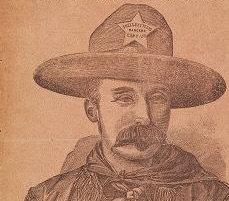
The recreation ground at Heaton Junction, on the site of which houses are currently being built for the first time, was from 1886 until 1892 the home of East End Football Club. It was here that one of the Magpies’ greatest ever players, Alec White, scored nine goals in a 19-0 win, still the club’s biggest victory, and where Tom Watson, who went on to great success with Sunderland and Liverpool, first cut his teeth in football management.

But in 1892 the railway company which owned the ground threatened to increase the club’s rent and was considering redeveloping the site and so East End’s directors decided to move the club to St James Park and rename it ‘Newcastle United’. Soon the land on which the ground stood would become a railway yard and it remained that way for the next 120 years. But let’s rewind.
In the summers of the 1880s and ’90s, the railway company derived additional rental income from athletics, cricket and cycling contests as well as other one-off events. One of these was ‘Mexican Joe’s Wild West Exhibition’.
Wild West
An advertisement appeared in the ‘Evening Chronicle’ on Monday 11 May 1891 and throughout that week:

Further information was given in another advert the following Saturday, the show’s opening night. It was explained that first of all ‘Mexican Joe’ would tell the story of his life and introduce his famous company of ‘cowboys, hunters and red Indians; also the old Tombstone coach. The Indians will give their Ghost Chant, and Old Uncle Sam, an ex-slave, will sing camp meeting songs.’ It went on to say that it was expected that everyone entering the site would give a ‘small amount for the Indian Mission in Dakota.’

Tombstone, Arizona was a frontier boom town in the 1880s due to the many silver and gold deposits in the vicinity and was the site of the famous ‘Gunfight at the OK Corral’ in 1881. Had a genuine stagecoach from there been shipped to Newcastle? Would anybody know?
So-called ghost chants and dances were part of rituals in some native American cultures, designed to protect the indigenous peoples and ward off colonialism. They became widely known the 1880s and popularised by the Wild West shows of Buffalo Bill and others. While genuine native Americans took part in many of the shows and they generally seem to have been well-treated, on the other hand they were stereotyped in the shows as aggressors and impediments to civilisation. In the late nineteenth century, people of the USA, Europe and, in this case, Heaton were being exposed to a somewhat one-sided view of very recent history.

Nevertheless the shows were incredibly popular entertainment. ‘Buffalo Bill’s Wild West Show’ was the most famous and had included The Town Moor and North Shields amongst its stopping places. ‘Mexican Joe’s Western Wilds’ wasn’t quite as well known but, that spring, it had already performed in Sunderland and North Shields for a week at a time. There would have been huge excitement as the 30 or so strong company set up at Heaton Junction.
Mexican Joe

It turns out that Mexican Joe was in fact (Colonel) Joseph Shelley, who seems to have been born around 1845 in Georgia, USA.
A ‘Sunderland Daily Echo’ reporter described the Colonel as ‘a man of about middle height, strongly made, with a bronzed, careworn, but kindly face, and singularly modest about his own exploits’. He reported that Shelley had written an autobiography according to which he had fought for the Confederates in the American Civil War and been disowned by his father, who was a staunch Unionist. Later, he said, he ‘went out West’ and served for five years with the Texas Rangers, before becoming a scout and seeing a lot of Indian fighting.
Shelley reported that he’d been captured and tortured but managed to escape. He said his home had been destroyed in his absence and his wife and children murdered. His last active service was said to have been in 1883, when he claimed to have assisted in the capture of Geronimo. He said that in 1887 he was brought over from Arizona to appear in the 1887 Jubilee International Exhibition in Liverpool, an event which celebrated Queen Victoria’s 50 years on the throne.
Palace Sensation
There are other contemporary press reports concerning Shelley, including one in a January 1888 issue of the ‘The Illustrated Police News’, one of the earliest British tabloid newspapers.
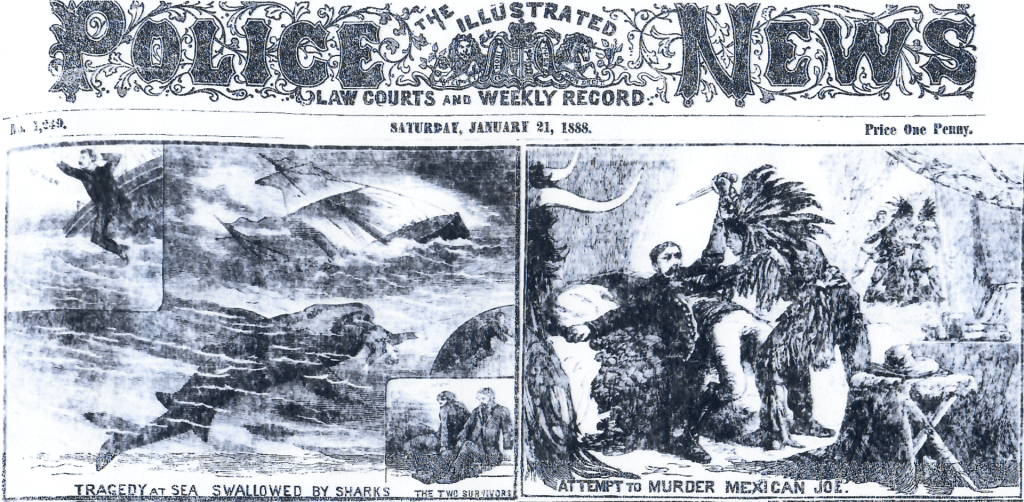
The paper had a reputation for sensationalism and xenophobia, to be magnified by the unsolved ‘Jack the Ripper’ murders, which took place later that year. (In fact, two of Shelley’s troupe ‘Colorado Charley’ and Richard Chester Dare were one-time suspects in the case. It was thought by many at the time that the murders were too brutal to have been carried out by an Englishman and so the movements of the travelling shows and in particular the native Americans in their casts were carefully examined.)
It is this context that one should read the account of threats and an apparent attempted murder of ‘Mexican Joe’ at the Albert Palace in Battersea, London by ‘Red Indians’, which was described in graphic detail.
The Albert Palace was a large iron and glass building, like the 1851 Crystal Palace. It was used for concerts, exhibitions, pet shows and the like. Famously, Arthur Lazenby Liberty, founder of Liberty’s, held an ‘Indian Village’ there at which Indian singers, dancers, jugglers, snake charmers and others demonstrated their skills. Perhaps that show’s success influenced Shelley. It should also be mentioned that by this time (1888), only three years after it opened, the palace was struggling financially. Perhaps, there is no such thing as bad publicity when it comes to selling show seats. Nevertheless that story was its final hurrah. Soon after ‘Mexican Joe’‘s residency, the Albert Palace closed permanently.
Disappearing Act
There was north-east press coverage too. A letter to the ‘Shields Daily News’ from W H Drayton, the ‘Mexican Joe Wild West Show’ secretary, just over a week after the ensemble left Heaton. It concerned a 12 year old boy from Bill Quay who apparently had run away to join the show. The letter writer who, on the 1891 census form, was described as a theatrical manager and was lodging in Jarrow, said that the boy had pleaded with Mexican Joe to let him stay, explaining through sobs that he had no home, no friends and no money and that his sick aunt could no longer afford to keep him. The lad was allowed to stay and work for his keep but eventually his father had turned up to reclaim his son. Perhaps in this case, bad publicity regarding the missing boy had to be addressed.
We have no way of verifying which of the details printed by newspapers of the time is true: Shelley was a showman, prone to exaggeration, half-truths and even lies. However, we’ve been able to look at official records from around the time of his appearance in Heaton.
Klondike
The 1891 census was conducted on 5 April 1891, just a few weeks before Mexican Joe’s Wild West Show appeared in Heaton. Joseph Shelley, aged 47, a ‘show proprietor’ from Georgian and Ada Shelley, aged 17 and from Kansas, ‘rider in show’ were lodging in Jarrow at the home of William Richardson, a shipyard labourer and described as a ‘widower’ and his three children, all of whom were at school. Joseph and Ada are both described on the census form as ‘married’ but we have found no official records to confirm this to be the case. There were other members of the troupe lodging elsewhere in Jarrow.
The next record we’ve found dates from 19 November 1897 when Colonel Joe Shelley placed an advertisement in ‘The Sheffield Independent’ and several other regional newspapers titled:-

However, there is nothing to indicate that anything came of this venture (except that Shelley likely acquired a collection of postage stamps). Certainly he was back in Jarrow at the time of the 1901 census.
On 31 March 1901, Joseph Shelley (recorded as being 55 although this doesn’t quite tally with his stated age in 1891) and now described as a ‘phrenologist’, was a boarder along with Florence Shelley (28), born in London. Again both Joseph and Florence are described as ‘married’. They were lodging at the home of Daniel Short, a ‘silver and gold repairer’ and his wife, Frances. There are three other boarders, Edward Hooker, also a ‘phrenologist’, and his wife Mary Ann along with Ole Parker, an engine fitter from Norway. (Phrenology was a pseudoscience that involves the measurement of bumps on the skull to predict mental traits.)
The End
Mexican Joe’s Wild West Show was advertised for the last time in the ‘Bray and Dublin Herald’ on 1 June 1901, promoting a short, Irish tour of Ginnett’s Circus, incorporating the Wild West Show.
After this, the whereabouts of the Shelleys is unknown. However, it is possible that they may have moved to Bradford to live with Florence’s sister Ada and her husband with Joseph pursuing his career as a ‘phrenologist’.
Their next confirmed appearance in the records is in 1910, when they appear on the SS Baltic’s passenger list, as Colonel Joseph B Shelley and his wife Florence. Florence’s sister Ada’s address in Bradford is cited. The ship left Liverpool on 12 November and arrived in New York nine days later
After this the trail runs cold until a notice appeared in the ‘California Death Index 1905-1939’, for a Joseph B Shelly, aged 65, who had died on 11 October 1911 in Los Angeles. It should be said that there are two other Joseph Shelley deaths in 1915 and 1920 but it is the middle initial B along with the birth date that seemingly confirms it to be ‘Mexican Joe’, even though the last ‘e’ in his surname is missing. Florence seems to have returned to the UK where she married a Reginald Norfolk (23), a butcher, in Bradford, on 22 October 1913 and died on 10 February 1939 in Harrogate, leaving £1023 between her husband Reginald and Albert Wilman, her brother.
Postscript
As we have already stated, some of Mexican Joe’s tales of his experiences in the USA and Africa must be taken with a pinch of salt because when all was said and done, he was a showman.
This is not to take away from the fact that the problems and logistics of keeping the show on the road in the late 1800s must have been quite a challenge. Without the extensive British railway system, it would have been nigh on impossible. (We know that Buffalo Bill and his show travelled by rail using three special trains.)
And ‘Mexican Joe’s Wild West Exhibition’ is a colourful part of the history of Heaton.
Can You Help?
If you know more about the ‘Mexican Joe”s Heaton Junction show or East End FC’s time at Heaton Junction or have memories or photos to share, we’d love to hear from you. You can contact us either through this website by clicking on small speech bubble immediately below the article title or by emailing chris.jackson@heatonhistorygroup.org
Acknowledgements
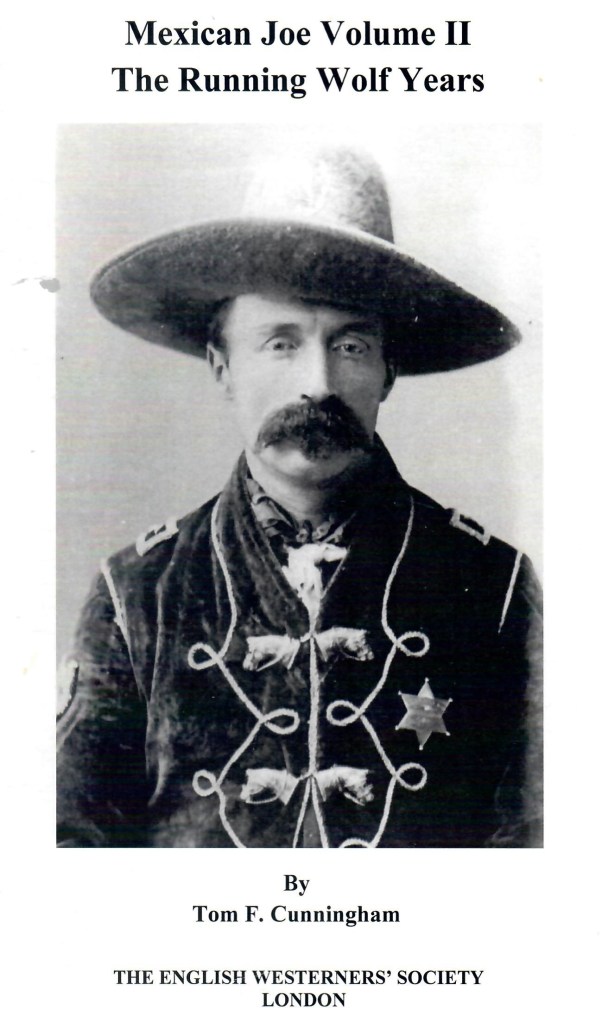
Researched and written by Arthur Andrews of Heaton History Group. Thank you to Tom F Cunningham, who has researched extensively the visits and lives of both Mexican Joe and Buffalo Bill (particularly in Scotland). However, Arthur did inform him about the Heaton Junction visit.
Tom has written an article and three books for The English Westerners’ Society:
‘Black Elk, Mexican Joe & Buffalo Bill – The Real Story’
‘The Lies and Legends of Montana Bill: Wild West Echoes in Glasgow’
Mexican Joe – The Red Eagle of the Sierras’
‘Mexican Joe Volume II – The Running Wolf Years’
Sources
‘All with Smiling Faces’ by Paul Brown; Goal-post, 2014
Ancestry
British Newspaper Archive
The English Westerners’ Society
Find my Past
and other online sources.