

Three generations of the Potter family owned and lived at Heaton Hall between 1840 and 1931 and left their mark on the public and business life of Heaton, Newcastle, Northumberland and the wider region. They were:
i. Addison Langhorn Potter (1784–1853)
ii. Addison Potter (1821–1894)
iii. Charles John Potter (1852–1931)
Guest writer, Douglas Edwards, will tell us more about each of them. But first, a bit of background.
There had been a manor house in Heaton since before 1135 when records show that Heaton Manor was given to Nicholas Grenville by Henry I. The ruin that we know as King John’s Palace or Adam of Jesmond’s Camera dates from around 1255. You can read a lot more about the hall’s history in Keith Fisher’s excellent ‘Castle on the Corner’ and find out more about a 1299 visit by King Edward I here. But the modern history of Heaton Hall can be dated to 1692 when Nicholas Ridley obtained the rights to part of Heaton Manor. In 1713, Richard Ridley rebuilt the hall and in 1778 Matthew Ridley commissioned William Newton to upgrade and modernise it. The attraction of a residence in Heaton to the Ridleys at this time was its convenience for their mining and other business interests and its proximity to Newcastle.
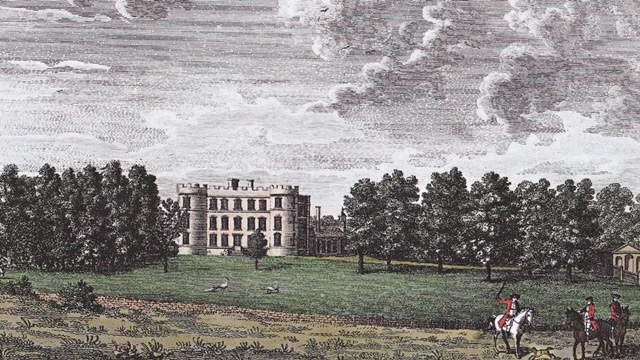
Later Ridleys, however, preferred Blagdon as a seat, particularly when the lands around Heaton Hall were disfigured in their eyes by an unsightly railway line and the frequent noisy, smelly trains that ran between Berwick and London.
So, in 1841 the Ridleys sold most of Heaton Manor with the hall and southern grounds being bought by Addison Langhorn Potter.
Addison Langhorn Potter was related to the Ridley family, being the nephew of the last owner of the hall, and he had been actively involved in joint business ventures with various members of the Ridley family.
Members of the Potter family were to reside at Heaton Hall for the next 91 years, spanning four generations in total. Over to Douglas.
Addison Langhorn Potter (1784 – 1853)
Addison Langhorn Potter was born to William and Ann Potter and baptised at Holy Cross Parish Church, Ryton. He established the foundation of the Potter family’s wealth through his involvement in local industries, notably brewing and mining, leveraging both family connections and personal enterprise. In addition, he pursued a political career, aligning with the Liberal Whig party.
Potter initially gained prominence as an Ale and Porter Brewer and Maltster, with his business listed in the Northumberland Trade Directory of 1827. The family’s involvement in brewing continued until 1918, when Addison Potter and Son, Maltsters, was acquired by Newcastle Breweries. Expanding his business interests, Addison became a partner in the Stella Coal Company Limited, Blaydon, in 1837 – a venture linked to the Ridley family. He was also a founding partner of the Newcastle Cranage Company in 1846.
In his later years, Potter diversified further, becoming involved in coke manufacturing and establishing a colliery agency at 7 Quayside, Newcastle, in 1848. That same year, he founded a firebrick and clay works at Willington Quay and pioneered a gas production plant. By 1851, he was recognised both as a coal owner and a brewer.
Beyond his business pursuits, Potter was an active figure in local government. In 1836, he was elected as Councillor for the St Nicholas Ward and in 1844-45 served as Mayor of Newcastle. His mayoralty as a Whig was not without controversy, culminating in an incident involving his eldest son, Addison, in December 1844 (described below).
In 1840, Addison moved with his wife Mary (1792–1876) and their six children—three sons and three daughters—to Heaton Hall. Upon his death in Heaton in 1853, his eldest son, Addison, inherited the estate and continued to expand the family’s industrial enterprises. Addison Langhorn Potter was laid to rest in the churchyard of Holy Cross Parish Church, Ryton where he had been baptised.


Addison Potter (1821-1894)
Addison Potter, Addison Langhorn Potter’s son, was born in 1821 into the prominent entrepreneurial family as the eldest son. Throughout his life, he worked diligently to expand and strengthen the family’s business interests and civic influence within Heaton and the Newcastle metropolitan area. Succeeding his father in both commercial ventures and public service, Potter emerged as a leading industrialist and an influential political figure in Northumberland. He also attained national recognition for his leadership from 1859 onwards in the Volunteer movement ( a citizen army which led to the Territorial Force in the twentieth century).
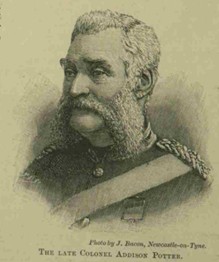
Raised at Heaton Hall, Potter later relocated to West Chirton House in North Shields following his marriage to Mary Robson (d 1905). In 1871, the family returned to Addison’s childhood home, where he resided with his wife and their six children—three sons and three daughters.
A man of strong family loyalty, Addison’s character was notably demonstrated in November 1844, when he was convicted of assaulting Mr Hernaman, editor of the ‘Newcastle Journal’. The altercation arose following an article that questioned his father’s integrity and his appointment as Mayor of Newcastle. Potter served two months in Morpeth Gaol, an incident that paradoxically enhanced his reputation locally, portraying him as a man of principle and staunch defender of his family’s honour.
Addison Potter played a pivotal role in reshaping and expanding the family’s commercial ventures. Initially working in partnership with his father, he later continued the enterprise with two of his sons, Addison Molyneux and Charles John, under the firm Addison Potter & Son. The firm became a significant contributor to the industrial and economic development of north-east England in the latter half of the 19th century.
The business portfolio of Addison Potter & Son was diverse. It included malt production, Portland cement manufacturing in Newcastle upon Tyne, ownership of the Walbottle Colliery and Firebrick Works, and the establishment of the Towneley Coke Works at Willington Quay in 1846. The facility featured 39 beehive coke ovens and an adjacent brickworks, which expanded by 1851 to include a joiner’s shop and additional kilns.

In 1862, Potter commissioned the construction of the steamship ‘Addison Potter’, designed to facilitate the distribution of goods along the North Sea coast. His business initiatives further expanded in 1867 with the opening of Addison Pit, part of Towneley Colliery, where the family maintained longstanding ties since 1837. Responding to increased demand for building materials, the Potters then founded a lime and cement works in 1881 at Willington Quay, on the former brickworks site.
Continuing his father’s progressive approach, Addison was an early adopter of technological innovations. He was a pioneer in gas production, establishing gas-making plants that supplied street lighting in Howdon and Wallsend. His commitment to social welfare was evident in his efforts to improve workers’ living conditions, which included the founding of Addison School and the development of Addison Village in Willington Quay. His public service extended to roles such as Commissioner for Income Tax and as a member of the Willington Quay Local Board from 1886.
Like his father, Potter was also a dedicated supporter of the Volunteer movement. He played a crucial role in the formation of England’s first Volunteer Artillery Company in 1860, eventually rising to the rank of Lieutenant Colonel and commanding the 3rd Northumberland Artillery Volunteer Corps. His military service was recognised with his appointment as Companion of the Order of the Bath in 1881 and the award of the Volunteer Decoration in 1892.

A memorable occasion at Heaton Hall was Addison’s testimonial in May 1869, when approximately 270 men from the 3rd Northumberland Volunteers paraded on the grounds, presenting him with a commemorative scroll and a silver-embossed cup. In gratitude, Addison hosted a grand banquet on the estate for the corps, with tables stretching 100 yards, lavishly supplied with meat, savouries, and beer.
In public life, Potter served as a magistrate from 1861, was elected to Newcastle Council in 1865, served as Mayor of Newcastle (1873–74), and was later appointed Alderman for Heaton Ward in 1877. He was also the inaugural Chairman of the Willington Quay Local Board.
Addison Potter passed away at Heaton Hall on 2 February 1894. His funeral procession departed from Heaton Hall two days later, with burial at Old Jesmond Cemetery.
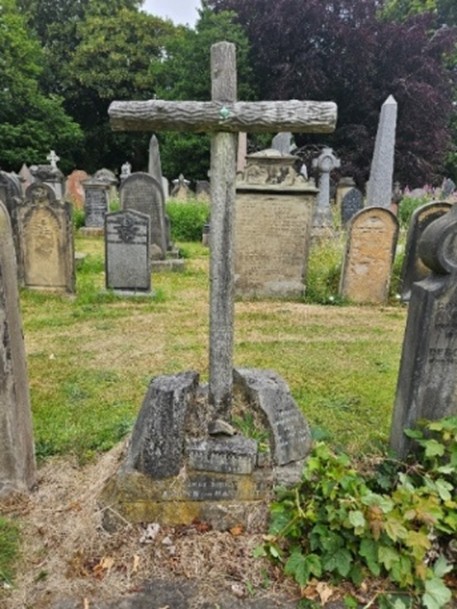
He bequeathed approximately £30,000 and Heaton Hall, along with its estate, to his son Charles John, who became the principal resident.
Charles John Potter (1852 – 1931)
Charles John Potter, born on 3 November 1852 and baptised in January 1853 at St. Peter’s Newcastle, was the second son of Addison Potter. He was educated at Cheltenham College, after which he joined the family business, focusing on the malting and cement operations at Willington Quay. Known for his imposing height of 6 feet 5 inches, Charles became a respected figure in business and society.

Following the death of his elder brother, Addison Molyneux, in 1899, Charles assumed overall responsibility for the family’s business interests. Upon retiring in 1909, he gradually wound down the family’s enterprises, overseeing their systematic sale over a nine-year period:
• In 1912, the cement business was sold to the British Portland Cement Manufacturing Company.
• In 1913, the Willington Cement Works were closed, with parts of the site sold to J T Eltringham & Co. for shipyard development.
• In 1918, the malting business, Addison Potter & Son, was acquired by Newcastle Breweries.
Following the sale of these businesses, Charles held several directorships, including seats on the boards of British Portland Cement, Northern Breweries, Northern Corporation Limited, and Newcastle & Gateshead Water Company.
Unlike his father, Charles refrained from active civic engagement but became a prominent figure in local sporting circles, especially in golf. He served as president of the Northumberland Golf Club and was also a dedicated Freemason. He was a Freeman of the City of Newcastle and served as Commissioner for Income Tax.
In 1905, Charles married Edith Fluitt (née Roberts) at St. Margaret’s, Westminster. They had one son, Charles Addison Potter, born in 1907.
Continuing the family’s tradition of military service, Charles joined the Volunteer movement, serving in the 3rd Northumberland Artillery Volunteer Corps. He attained the rank of Honorary Major and Captain of the 4th Battery, receiving the Volunteer Decoration in 1892 alongside his father and brother.

In retirement, Charles occasionally opened Heaton Hall to antiquarian and archaeological groups, personally guiding tours and sharing his extensive knowledge of the estate’s history. The 1930 electoral roll documents a thriving community at Heaton Hall, including Charles, Edith, their son Addison, and several long-serving household staff.
Charles John Potter passed away at Heaton Hall on 10 July 1931 after a brief illness. His funeral service was held at St. Gabriel’s Church, followed by interment in the family plot at Jesmond Old Cemetery.
Shortly before his death, the City of Newcastle issued a compulsory purchase order for part of the Heaton Hall estate to facilitate the widening of Heaton Road.
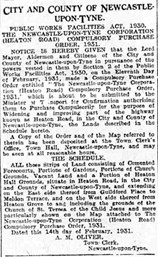
Following his passing, Mrs Potter and their son decided to vacate Heaton Hall and sold the estate and its remaining lands to W E Hall & Son of Gateshead, marking the end of the Potter family’s residence at Heaton Hall.
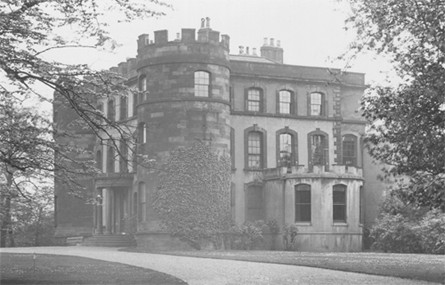
The Hall was demolished in April 1932, and the remaining estate was redeveloped for residential housing which you can read about here.
Acknowledgements
Researched and written by Douglas Edwards and first published by Heaton History Group on 29 August 2025.
Douglas is an historical and social geographer by education, raised in a service family and an active family historian. Combining his academic and military service background with personal passion, he developed a specialist collection of Volunteer medals and decorations, with a particular emphasis on the British and Indian Volunteer movements. His interests extend beyond collecting; and is found actively researching and writing about the lives of the medal recipients, with a focus on understanding and presenting their stories within their broader historical and social contexts. He has worked with a number of family and local history groups and has had a number of articles published.
Thank you also to John Potter, direct descendant of the Potters of Heaton Hall for the help he gave to Douglas.
Can You Help?
If you know more about Addison Langhorn, Addison or Charles John Potter or any members of the Potter family or their staff at Heaton Hall or have photos to share, we’d love to hear from you. You can contact us either through this website by clicking on small speech bubble immediately below the article title or by emailing chris.jackson@heatonhistorygroup.org


Well done, and thank-you Mr Edwards.