

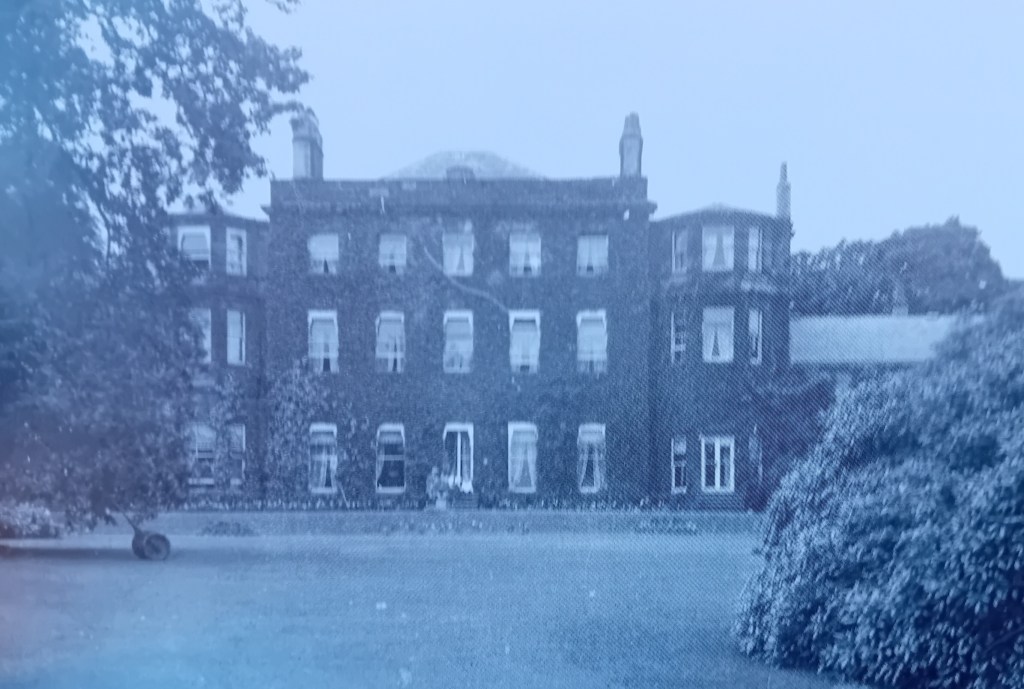
If you were to stand in the Lochside Pub having a pint (or other drink of your choice) and suddenly found yourself transported back in time 100, 200 or even 250 years you would emerge in, or very near to, Benton Hall, an impressive 18th century mansion. This article tells the story of the hall and the people who owned and lived in it over a period of about 170 years.
Introduction
During the 18th and 19th centuries many mansions were built in Newcastle’s rural hinterland, many of them funded by the profits of coal-mining. Three such mansion houses were developed in the area between Longbenton Front Street and what is now the Coast Road in the 18th century: Benton Hall, the focus of this article, which was located to the east of Red Hall Drive in the vicinity of the Lochside Pub; Benton Park House, which was located to the west of Red Hall Drive, in the area which is now occupied by Cochrane Park Estate; and Benton House, in Longbenton Village. All three houses appear to have been built by members of the prominent Bigge Family who were landowners, lawyers and merchants and accumulated a great deal of wealth by leasing the royalties to the coal underlying their estates, including the Little Benton Estate which included the land on which the Cochrane Park Estate was built in the 1930s/40s.
This article tells the story of Benton Hall (also known as the White House and sometimes Little Benton Hall) which was occupied by several members of the Bigge family and later by a notable local industrialist and then a banker. In the mid 19th Century the estate surrounding the house would, for a short time, become an early visitor attraction in the form of botanical gardens which were open to the public.
Origins
The mansion is thought to have been built in about 1760 by Thomas Bigge who was the son of another Thomas Bigge, a wealthy landowner and lawyer, who came to own land in the Little Benton area through his marriage to Elizabeth Hindmarsh in 1706. By the time the Hall was built the Bigge family owned most of the land in the Township of Little Benton which stretched from Heaton’s traditional northern boundary, which ran through the area now occupied by North Heaton bungalows, as far north as what is now the Newcastle United Football Academy.
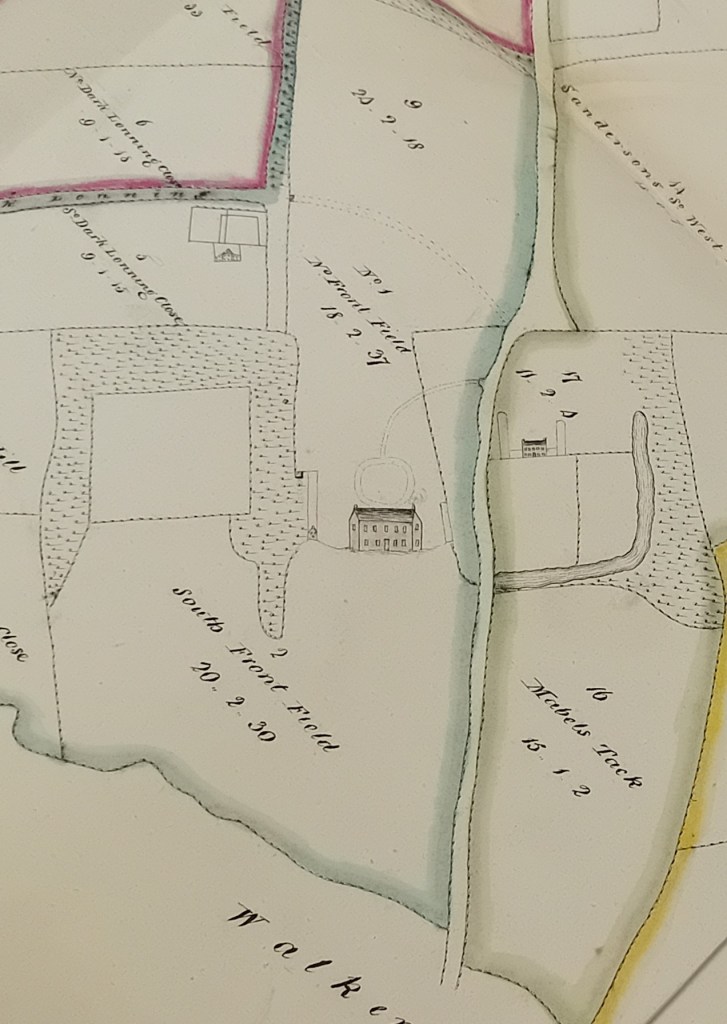
The plan extract below, dating from the late 18th century, shows Benton Hall, to the east of what was then known as Benton Lane (now Red Hall Drive). The neighbouring mansion, to the west of the lane is Benton Park House which, though its early history is obscure, was probably built by Thomas’ brother William. In the plan Benton Park House is depicted as much larger than Benton Hall but this is misleading and is likely to reflect the fact that the plan was made for the owner of that house. Documentary evidence from the late 19th century suggest the two houses were of comparable size. An ornamental lake is shown curving around the south and east of Benton Hall. The surrounding grounds, including woodland, gardens and grassland, comprised about 35 acres. The estate was bounded to the north by a lane which is now Meridian Drive, to the west by Benton Lane and to the south by the Wallsend Burn (subsequently culveted).
Thomas is said to have been a mercer of Ludgate Hill in London, but he retained the house and estate in Little Benton until his death in 1791. Following his death the house was occupied by his son, yet another Thomas Bigge. Born in 1766, Thomas was an interesting character. In the later years of the 18th century he became a political activist and tract writer and an associate of well known reformer Christopher Wyvill. In the period 1798-99 he edited and partly funded a short-lived magazine entitled ‘The Oeconomist , Or Englishman’s Magazine’ with the assistance of his friend James Losh. Losh was a lawyer and became a well known reformer and Unitarian in Newcastle and a stalwart of the Literary and Philosophical Society of Newcastle Upon Tyne (he was its Vice President for over 30 years) – a full length statue of him stands on the staircase of the Society’s premises.
Thomas also played a significant role early in the life of the Lit and Phil which he joined in 1795 and he was a key promoter of the establishment of ‘The New Institution’ in Newcastle whose concept was set out in a paper ‘On the Expediency of establishing, in Newcastle-upon-Tyne, a lectureship on the subject of Natural and Experimental Philosophy’, read out at a meeting of the Lit and Phil in May 1802. The New Institution was launched on 16 November 1802.
Thomas’ mother was the sister of Phillp Rundell, a highly prosperous English jeweller who co-founded the London based company Rundell, Bridge, & Co. Thomas would eventually join this company and he seems to have left Little Benton by around 1810 following which the house was occupied by a close relative of his, Thomas Hanway Bigge, with whom he is sometimes confused.
Thomas Hanway Bigge
Thomas Hanway Bigge (1784-1824) was the brother of Charles William Bigge who lived at Benton House in nearby Longbenton village until 1812 and was the heir to an extensive landholding in the Little Benton area much of which remained in the Bigge family until 1861.
By profession Thomas Hanway was a banker. He became a partner in the Newcastle based ‘Old Bank’ in October 1807, a short time after his brother Charles William was admitted to the firm which was now being styled ‘Ridley, Bigge, Gibson, & Co’.
In a Newcastle Courant article of January 1824 Thomas was listed as living at Little Benton and he died on 24 October 1824, being buried in Ovingham. Like the previous occupant of Benton Hall, Thomas Hanway was a friend of James Losh who wrote in his diary on 21 November 1824: ‘My poor friend T.H. Bigge was buried today. He died after a tedious, tho’ not upon the whole very distressing illness….He was an upright man, independent and liberal in his principles and extremely valuable as an active promoter of useful establishments of all kinds‘. Losh further noted that “Bigge was not without his faults but they were faults ‘in form’ and not ‘in substance’ and even those were lessening every day as he gradually overcame the defects of his education and the prejudices he imbibed from those aristocratic friends and connections whom he had early been taught to look up to with undue respect”.
Thomas Hanway’s wife, Charlotte, seems to have continued to live in Benton Hall after his death. A local directory lists her as living in the Hall in 1828 but it seems that the house was sold not long after this.
William Losh
Interestingly, the next occupant of Benton Hall was William Losh (1770-1861), the brother of the aforementioned James Losh who had been a friend of both Thomas Bigge and Thomas Hanway Bigge. Losh, a chemist and industrialist, who had previously resided at Point Pleasant House in Wallsend, seems to have moved into Benton Hall in the late 1820s. His new neighbour, Charles Clarke of Benton Park House, had actually sold him Point Pleasant House.
Losh played an important role in the development of the chemicals industry on Tyneside. From a wealthy family with mining interests he had received much of his education abroad in Hamburg, Sweden and Paris. He was in Paris at the outbreak of the French Revolution and in 1790 he and his brother John, along with Archibald Dundonald, experimented in the production of soda from salt and subsequently set up a works at Bells Close west of Newcastle. In 1807 they moved to Walker, establishing the Walker Alkali Works, which took advantage of a salt spring in the King Pit which the Losh family had an interest in. In 1816 Losh returned to Paris to study a new process for making alkali which had been developed by a French chemist during the revolution and he is credited with being the first to introduce the Leblanc process in the UK. In 1809, shortly after the establishment of the alkali works in Walker, the company Losh, Wilson and Bell set up an ironworks there.
Losh was an associate of George Stephenson. Richardson (1923) notes that ‘the budding railway engineer often spent a large proportion of Sunday at Point Pleasant, where the enginewright and the chemical manufacturer used to plan out improvements and experiment, while the draughtsmen of the Walker ironworks (brought down to Wallsend by Mr Losh) would draw their rough sketches to scale and put them into a workable shape‘. The two men would go on to obtain numerous patents together and Losh himself invented many improvements in furnaces, boilers, tramways etc.

Botanical Gardens
In the mid-1850s the estate became a botanical gardens, although this was a short-lived enterprise. The establishment of ‘The Northumberland and Durham Botanical Gardens’ was driven by a joint-stock company, whose capital was £10,000. The grounds opened to the public with great fanfare during the Whitsun Bank Holiday weekend of 1854. The following account of its first opening to the public appeared in the Newcastle Guardian and Tyne Mercury on 10 June 1854:
‘THE BOTANICAL GARDENS – On Whit Monday and Whit Tuesday, the extensive grounds at Benton intended for the ‘Northumberland and Durham Botanical Gardens’ were temporarily opened to the public and large numbers from this town and the surrounding area availed themselves of recreation and amusement afforded to them. The gardens have not by any means been laid out in that admirable and pleasing style which is contemplated; yet their pleasant situation is much admired, and the portion open on Whit Monday and Tuesday gave general satisfaction and delight, and there were scenes of the greatest enjoyment among those assembled. On Monday upwards of two-thousand persons visited the grounds. Various amusements were engaged in by the assemblage of both sexes, and each evening there was a brilliant display of fire-works from the gardens’.
John Anthony Woods
By the late 1850s the house was owned and occupied by John Anthony Woods, the son of William Woods who was a founder of a then well known Newcastle banking firm Wood and Co. John Anthony became head of this firm on his father’s death in 1864, a position he held for about 35 years. The firm occupied premises at the corner of Mosley St and Pilgrim St and in the late 1890s amalgamated with the firm of Messrs. Barclay & Co.
In the 1871 Census John Anthony, his wife and six children were shown living at Benton Hall. Living with them were 15 servants, listed in the Census as follows: Governess, Nurse, School Room Maid, Kitchen Maid, Scullery Maid, Butler, Footman, Page Boy, Cook and Housekeeper, Lady’s Maid, Laundry Maid (2), Housemaid, Groom and Coachman. In 1891 John, by then 75, was still living there with two of his sons and 14 servants.
Woods died in September 1901 leaving Benton Hall to his son, James Edward Woods. In May of the following year a stained glass window and a reredos were placed in Longbenton Parish Church in his memory, the reredos being made by Ralph Hedley. A memorial plaque tablet was also erected in the Lady Chapel of St Nicholas’ Cathedral, the elaborate carved oak frame also manufactured by Hedley.
The End of an Era
An auction of the house’s contents took place in October 1901 and the house was advertised for letting in January 1902. The advert placed in the Newcastle Journal gives us a description of the mansion’s accommodation: ‘The home contains 25 bedrooms, drawing room, dining room, library, billiard room and study, housemaids and butlers pantries, housekeepers room, servants hall, wash-house, laundries, kitchens, etc’. Interestingly the advertisement stated “electric light and telephone will be added if desired’. The whole estate comprised 35 acres of which 14 acres were gardens, grounds and woodland and 21 acres were grassland. There must have been no takers as later that year an advert was placed advertising that the house was to be sold be Auction. However, before the auction could take place the property was bought by William Watson-Armstrong (1st Baron Armstrong), the great nephew and heir of Lord Armstrong of Cragside, who already had an extensive landholding in Heaton.
Whilst the mansion was reportedly in good condition in 1902, it is not clear that it was ever occupied again although it was advertised to let in September 1903 and again in October 1912. A report in ‘Newcastle Daily Chronicle’ on 1 August 1913, entitled ‘The Sylva of Benton Hall’ gives us an evocative picture of the house and gardens at that time:
‘Since it ceased to become a residential estate it may be said that the glory of Benton Hall has departed , for there is not now any necessity for the smoothly shaven lawn, the neatly trimmed borders, the gay parterres, the beautiful pleasance of the days when the big home was occupied. The forsaken mansion gives an air of sadness to the immediate surroundings, but the adjacent vinery, conservatories, and gardens are under proper guardianship and are not allowed to become waste. And above all the trees remain as they were. They require little or no attention, go on from year to year, unfolding bud and blossom and foliage, as if all the world were there to see them. A fine walnut tree stretches forth its fragrant boughs towards the empty hall, a magnificent sweet chestnut , with a trunk 11 ft or 12 ft in circumference, stands boldly in the foreground, and close by are stately oaks and huge silver willows. One of the finest specimens of the cut-leaved beech is to be seen here, close to the ornamental lake. Its spreading branches cover a huge space, and completely exclude the sunlight. Near the hall is a sweet bay (Laurus noblis) which only requires to be touched to exhale its delicious scent.’
After 1913 Benton Hall is seldom mentioned in any records except as a place where tennis was played. In May 1927 it was reported that ‘the Avenue Lawn Tennis Courts, which are situated in the grounds of Benton Hall, North Heaton, have been opened’.
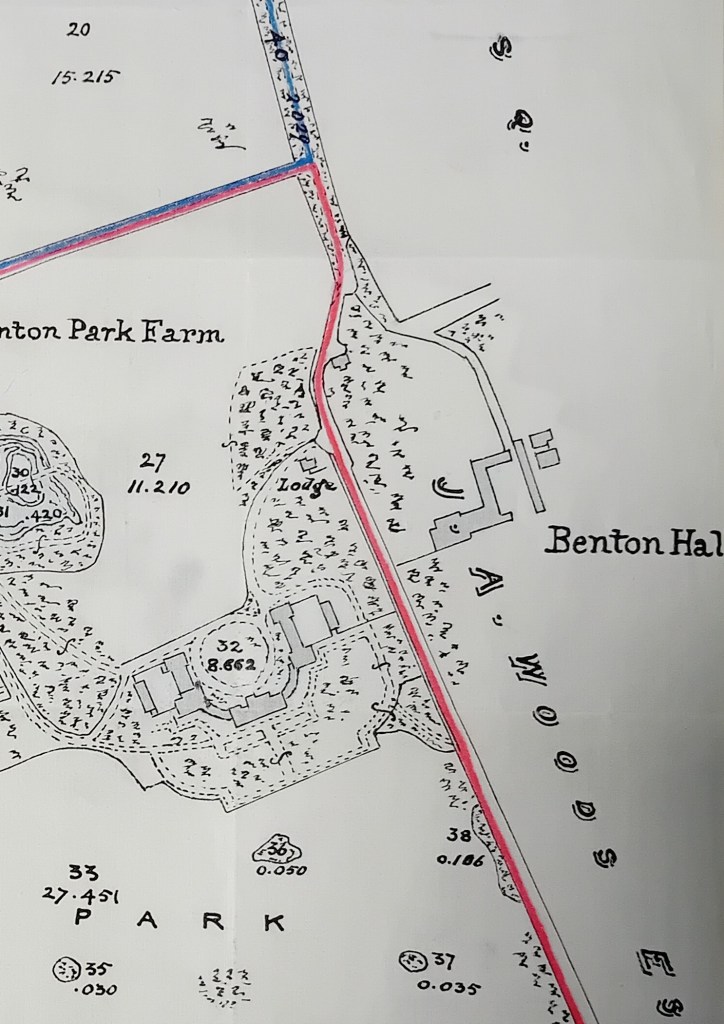
It appears that the North Heaton Development Company acquired the Benton Hall Estate from the 1st Baron Armstrong in the late 1920s or early 1930s for housing development. This company would be responsible for planning and taking forward much of the massive suburban housing expansion which took place in the northern part of Heaton in the 1930s and 1940s. This included not only the Cochrane Park Estate, which was built on the grounds of Benton Hall and the adjacent Benton Park House, but also St Gabriels, Newton Park and North Heaton Bungalow Garden City. The development of the Cochrane Park Estate (referred to early in its development as the Benton Hall Estate) commenced in 1934 and the demolition material from the Hall went to infilling the old quarry on Newton Road which subsequently became the ground of Heaton Stannington Football Club.


The Lochside Pub which, as previously stated, stands roughly on the vicinity of the old mansion, was opened in 1954.
Sources
‘The Diaries of James Losh’, The Surtees Society Vol. CLXXI, Vol 1 1811-1823 / Edited by Edward Hughes
‘High Heaton Cochrane Park Benton: How we used to live ‘/Alan Morgan, Tyne Bridge Publishing (1923)
‘A History of banks, bankers and banking in Northumberland, Durham and North Yorkshire illustrating the commercial development of the north of England , from 1755 to 1894, with numerous portraits, facsimiles of note, signatures, documents [etc]’ / Maberly Phillips, Eppingham Wison & Co.,(1894)
‘History of the Parish of Wallsend’ / William Richardson (1923)
‘Lost Houses of Newcastle and Northumberland’ / T.Faulkner and P. Lowry (1996)
‘Northumberland’s Lost Houses’ / Jim Davidson, Wagtail Press (2008)
Seymour Bell Longbenton Portfolio, Newcastle City Library
Acknowledgements
Researched and written by Alan Richardson of Heaton History Group.
Can You Help?
If you know more about Benton Hall or have memories or photos to share, we’d love to hear from you. You can contact us either through this website by clicking on small speech bubble immediately below the article title or by emailing chris.jackson@heatonhistorygroup.org


Very interesting story of the two Benton Houses. I am a bit confused as to where the Cochrane Park dwelling featured. I vaguely remember one of the Potter children marrying into that family and moving there but it is vague and without a wholesale operation delving into my archives I am left in hope someone might disabuse me.
I’m pleased that you found the article interesting Keith. Another article about Benton Park House, the mansion which sat to the west of Red Hall Drive, is currently in preparation and should appear of this site in due course. It seems that this house was built by another member of the Bigge family but its early (i.e. 18th Century) history is proving rather difficult to piece together. We know more about the people who occupied the house in the period after 1808: the family’s of William Clark, Major John Potts and Edward Liddell. Do any of those names ring a bell with you? Research to date hasn’t thrown up a link to the Potters but it wouldn’t be a surprise given the closeness to Heaton Hall.
The links between the well off and their grand houses with the chemical works in Walker seem to be quite a recurring theme. I was reminded of Cuthbert Hunter and his residence of Meadowfield House though on a less grand scale. Interesting stuff
Brenda Durham sent us some memories:
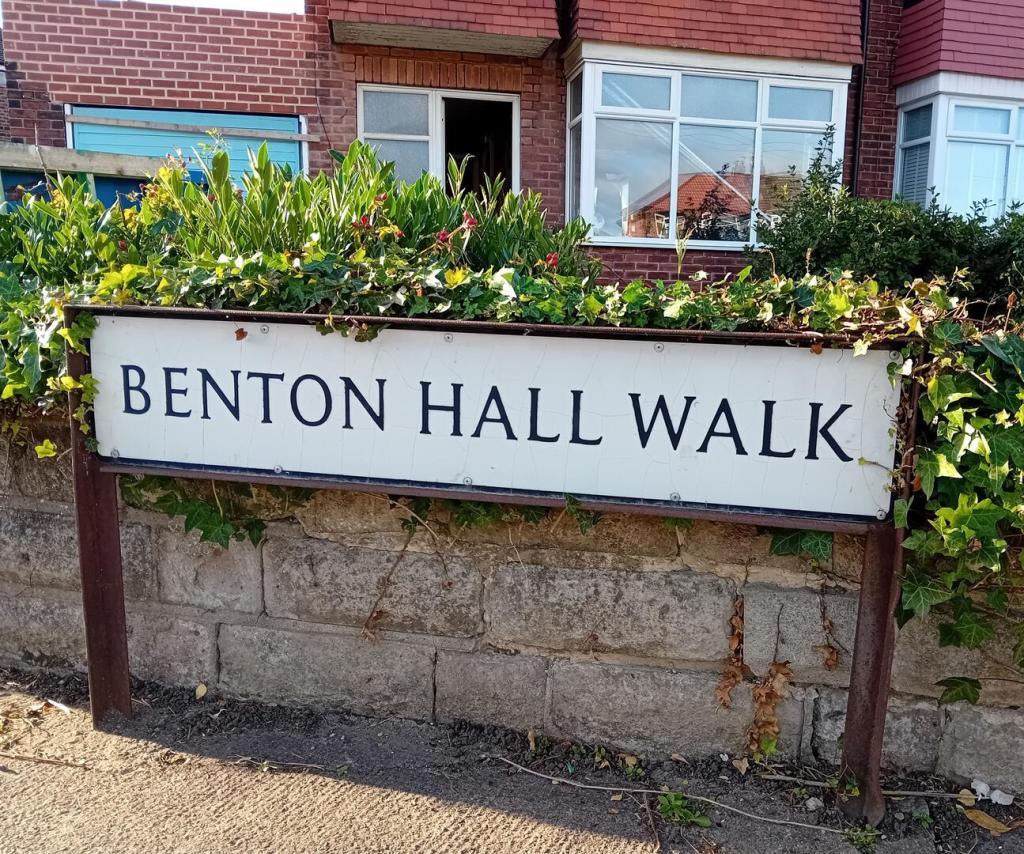
I was born and grew up at 3 Benton Hall Walk, which was in the middle between Sherfield Drive and St Julien Gardens. If the photograph shown in the article on the Halls on the website is No 1 then I remember its was owned by Newcastle United and Bobby Crowe lived there when he played for them. At number 2 were a family from Bristol, working for Wills Tobacco Factory on the Coast Road. Their identical Bristol Art Deco factory was demolished years ago, while ‘ours’ became flats, as we all know.
Another memory is at a very young age being taken by brother David (Shepherd) to what we called the Waste Ground and down a hole in the ground to see the Wine Cellar from the old Hall (which we imagined as Red Hall, wrongly) with a few empty and very dusty bottles intact, where The Lochside pub is now. Also mention of a burn and stream, reminds me of a plank of wood we used to walk across with water down below where Warwick Hall Walk is now, near the top of Vancouver Drive, behind Red Hall Drive.