

Although powered flight had been possible for a couple of decades before Joy Tamblin (née Laing) was born, she still deserves a place among the panoply of Heaton’s aviation pioneers.
Joy’s Heaton connections went back to her father, Albert, who during WW1 was living with his family at 3 Chillingham Road. In 1915 Albert, a salesman, joined the 3/1st Northumberland Hussars but a little over a year later, he was discharged, emphysema and an abscess in his right lung meaning that he was deemed unfit for active service. Her mother, Olga, meanwhile, was one of the first women officers in the Women’s Auxiliary Army Corps. She must have been an inspiration to her daughter. By the time that (Pamela) Joy was born on 11 January 1926, the family, which included her older brother Derek, were living in Jesmond.
When she was 11, the Laings moved to Edinburgh where Joy began secondary school but they returned to Newcastle and Jesmond in 1940 and the now 14 year old Joy attended Heaton High School for Girls. Her first year or so at the school, however, was spent in Kendal where most pupils, together with many teachers and Miss Cooper, the head teacher, were evacuated. Apart from that, we don’t have much information about Joy’s time at Heaton High but she was clearly gifted academically, although she opted not to go on to higher education. In 1943, with the war still on, she joined the ATS (Auxiliary Territorial Service) and then spent two years at Bletchley Park as a code breaker with the Intelligence Corps. At the end of the war, Joy was discharged as a Corporal.
It was now that she decided to go to university. In 1949 she graduated with a Durham University BA (Hons) in Geography, having studied at Kings College, Newcastle. In the same year her engagement was announced to a fellow graduate but they did not marry. There followed what Joy described as an uninspiring two years as an Assistant Council Planning Officer in Essex.
WRAF
Then came a move that changed Joy’s life. She moved back to Newcastle and joined the WRAF at the Sandyford Road recruitment Office, accepting a Commission in the WRAF Education Branch.
She did 12 weeks of officer training, following which she managed an education centre.
In 1954, still with the education branch, Joy was stationed at RAF Wahn in Germany, with the WRAF, as part of the 2nd Allied Tactical Air Force. It was here that she first took to the skies. At the time, across nine gliding clubs, there were 250 airmen, but not one airwoman, who could operate a glider. This changed with Flight Officer Joy Laing. She explained later how she made several trips in a dual machine to get air experience before starting with the instructors on ‘ground slides’, the winch towing of the glider along the ground at 20 mph. Having done this half a dozen times to get a feel for the controls, she was allowed to ease the stick back and lift the trainer into the air for short towed flights. After becoming proficient in gliding, she was invited by the Wahn Club to join the Wahn Club ground crew for the 2nd ATAF gliding championships.
Her aim was to enter the championships as a flying member of the club the following year but instead she was on the move. In 1955, Joy was transferred to the administrative branch, completing an Advanced Officers training course in personnel and general management.
From then on, Joy’s career was a series of ground-breaking achievements as she gained experience in different sections and roles in the WRAF including Secretarial (later Administrative) Branch; Schools Liaison Recruiting; Account Officer, Staff College and Maintenance Command.
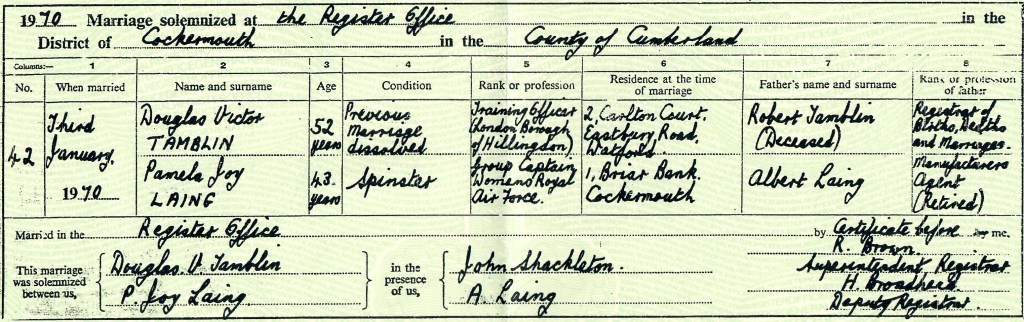
She was one of two WRAF Officers in her year to graduate from the RAF Staff College along with 40 men. And, significantly her career did not end when, in 1970, Joy, now a Group Captain, married Douglas Victor Tamblin*, a former RAF serviceman and teacher, who was now a Training Officer for the London Borough of Hillingdon.
In 1971, based at RAF Spitalgate in Grantham, she was the only RAF Station Commander who was a member of the WRAF. And three years later, she made history by becoming the first woman to hold the position of Command Accountant, a senior financial role.
Top Job
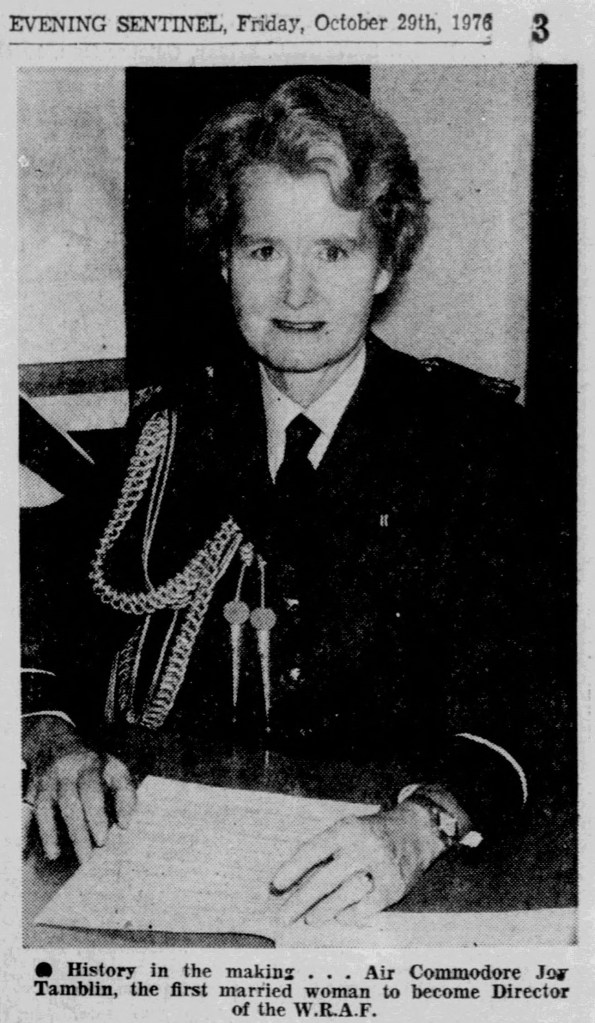
But Joy was to go higher still. In October 1976 she was promoted to the senior rank of Air Commodore, as Director of the Women’s Royal Air Force. She was in charge of more than 4000 air women and officers. This was a historical moment, as she became the first married woman to hold the post since the WRAF was formed in 1949.
She regarded her appointment as ‘a sign of the changing times’. In this role she had the additional honour of being an honorary Aide-de-Camp to Queen Elizabeth II. This is a ceremonial position held by only around 60 forces personnel. Duties include processing at coronations and state funerals. Joy did not have to do that but in 1976, following her appointment as Air Commodore, she had the honour of being received by Queen Elizabeth the Queen Mother at Buckingham Palace.
And Joy’s abilities and achievements were recognised beyond the armed forces. In 1977, she was appointed a Fellow of the British Institute of Management (FBIM); in 1979, both a Fellow of the Chartered Management Institute (FCMI) and a Fellow of the Royal Society of Arts (FRSA).
Media Interest
Naturally, Joy’s rise to the top captured the interest of the media. Here are just a few of the somewhat excruciating headlines about her (to which we have just added):
‘Flying high Joy from Heaton’
‘Top job for Geordie Joy’
‘Joy wings ahead’
‘Where a woman can take off for the top flight’
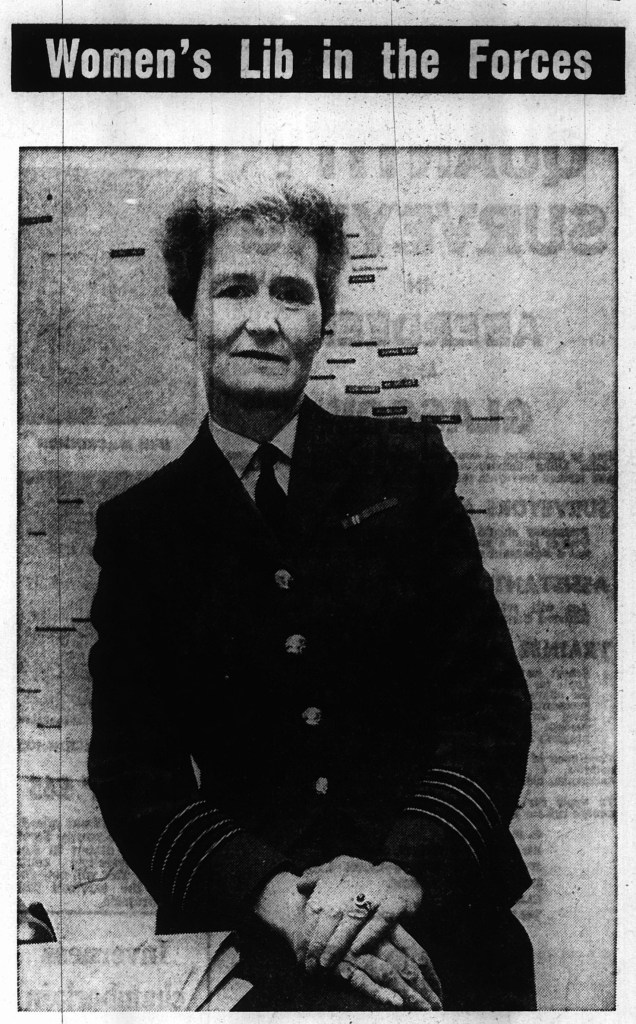
‘Women’s Lib in the Forces’
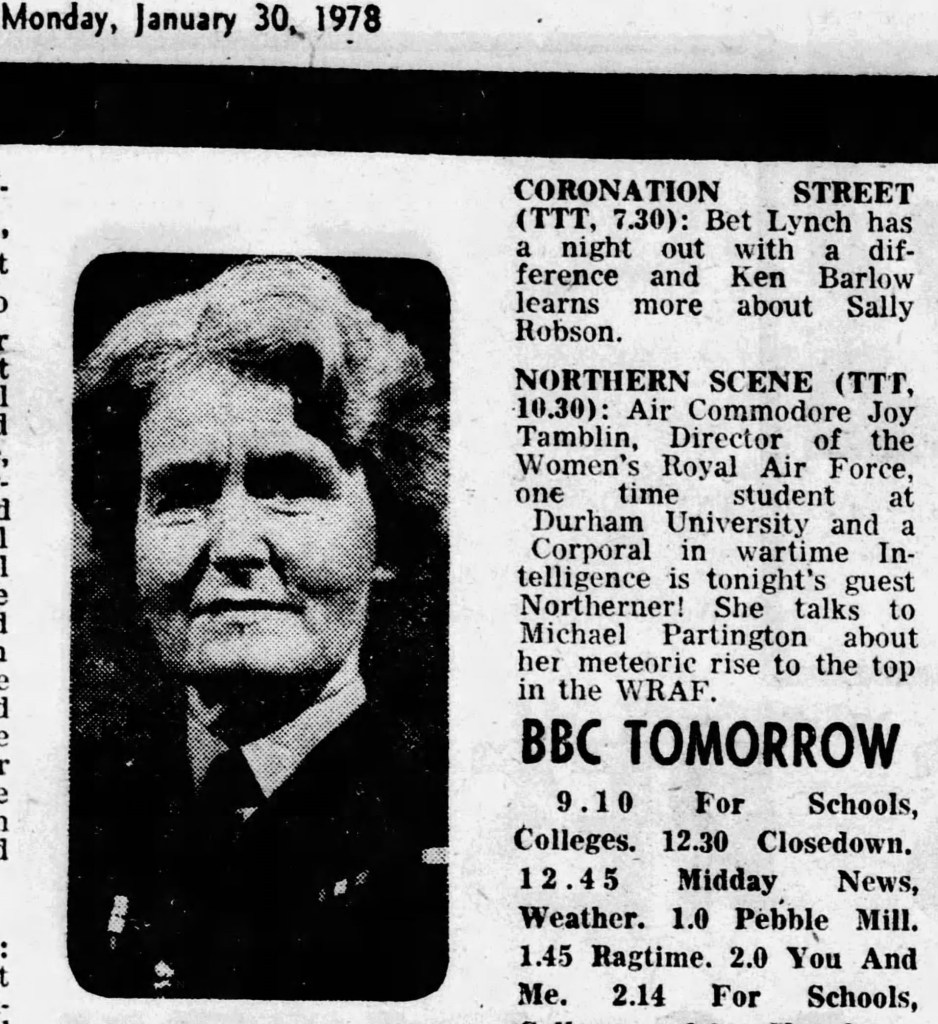
In 1978 she made an appearance on Tyne Tees Television’s ‘Northern Scene’ programme. She was interviewed by Michael Partington about her ‘meteoric’ ‘career.
But although some of the headlines might make us cringe half a century later, Joy was an important role model and, through her media profile, demonstrated to other women and girls what was possible and to men too that times were changing.
NATO Conference
In 1979 RAF Commodore Joy Tamblin chaired an important conference about ‘The role of women in the fighting services’. The delegates were all senior women officers. Joy said that there was no intrinsic reason why women should not break with tradition and take on full combative roles. She said that women could become first class fighter pilots and command a warship as effectively as a man. This was not a view that was commonly expressed at the time.
She told the conference that she would have made a great Battle of Britain pilot, if only she had been given the chance. (Perhaps difficult as she was only 14 years old in 1940!) She also said that the Navy was scared to send men and women to sea for long periods.
The reporter described her as ‘a colourful, out-spoken and brilliant female’ who ‘would have flown rings around the Germans in WWII’ .
Tapestry
In 1979, members of the WRAF in the UK and Overseas were commissioned to produce a 24 block tapestry to celebrate the 60th Anniversary of the RAF, to be displayed at the RAF Museum in Hendon, London. The tapestries each measured 20 inches by 16 inches and depicted aircraft from the inception of the RAF in 1919 to the most modern aircraft at the time eg Sopwith Camel, Spitfire, Lancaster Bomber to the Harrier Jet and Nimrod. Squadron Leader ‘Mac’ Horne made the original design and was the only man to have had a hand in some of the needlework. The project took 35 service people 18 months to complete, in their spare time, which was estimated to have taken 2.5 million stitches.
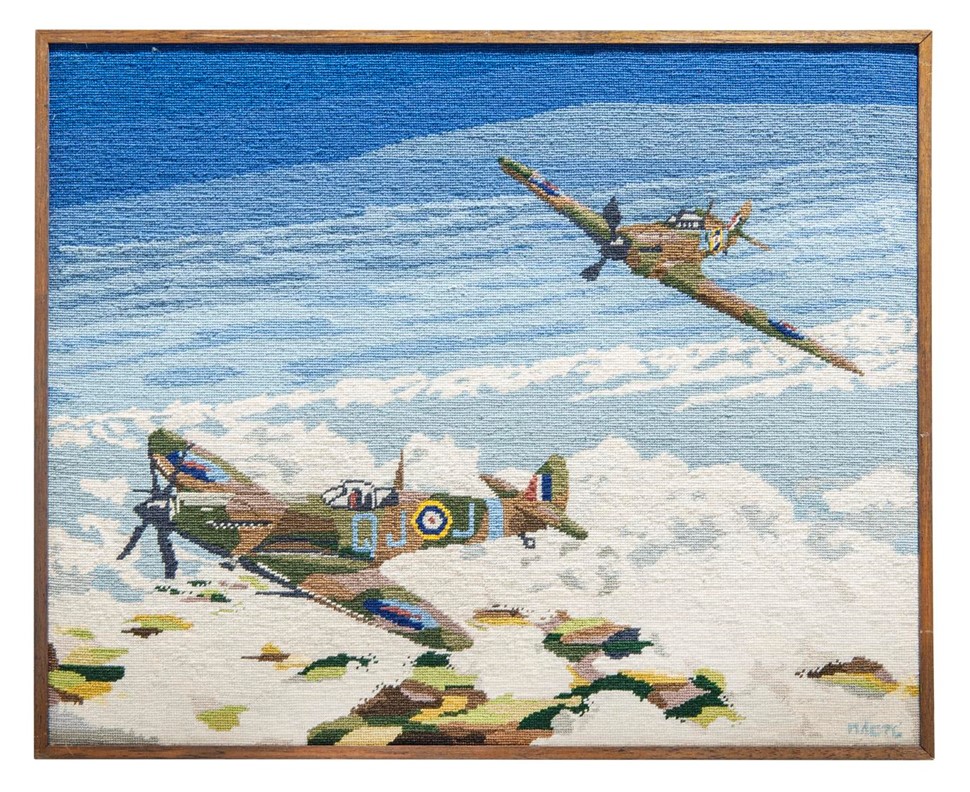
Heading the display was a panel with a selection of RAF Squadron markings embroidered by Air Marshall HRH Princess Alice, Duchess of Gloucester who was Air Chief Commandant of the RAF. Another panel of markings was worked by the Director of the WRAF, Air Commodore Joy Tamblin.
Equality
In a newspaper article she expressed her delight in the political success of Margaret Thatcher, saying that she was clearly a believer in the equality of women.
She said that she herself had been determined to be successful in getting her degree, taking exams and getting as much experience as possible. She wanted to prove that she possessed the qualifications for doing the job:
‘The WRAF provides obstacles – targets for you to reach and then having overcome that one, you make for the next obstacle and so on. It is challenging but this is a way, that those in the WRAF can proceed to improve their qualifications and can get on.’
She described how she developed skills as an interviewer, projectionist and public speaker and learned how to manage accounts. It was these impressive transferable skills that enabled her eventually to rise from Flying Officer to Air Commodore.
In Joy’s curriculum vitae, she said: ‘My entire service career has been characterised by assessing factors, making decisions, then planning, organising and controlling the implementation of those decisions. This has been so at ever increasing levels of responsibilities and the widening of areas of responsibility from junior officer to air commodore’
She added that she believed that North East girls in the WRAF were ‘Practical, sensible and sound’.
Retirement
Joy retired from the WRAF in 1980, aged 54. She was appointed, ‘Companion to the Military Division of the Order of the Bath’, in that year’s Queen’s Birthday Honours List.
After retirement, her hobbies and recreations were listed in ‘Who’s Who’ as charitable works, tapestry, the church choir and fell walking. She and her husband were settled in Cornwall where she was also President of the South East Cornwall RAF Association and Chairwoman of South Western Area Council of the RAF. But she hadn’t finished with flying.
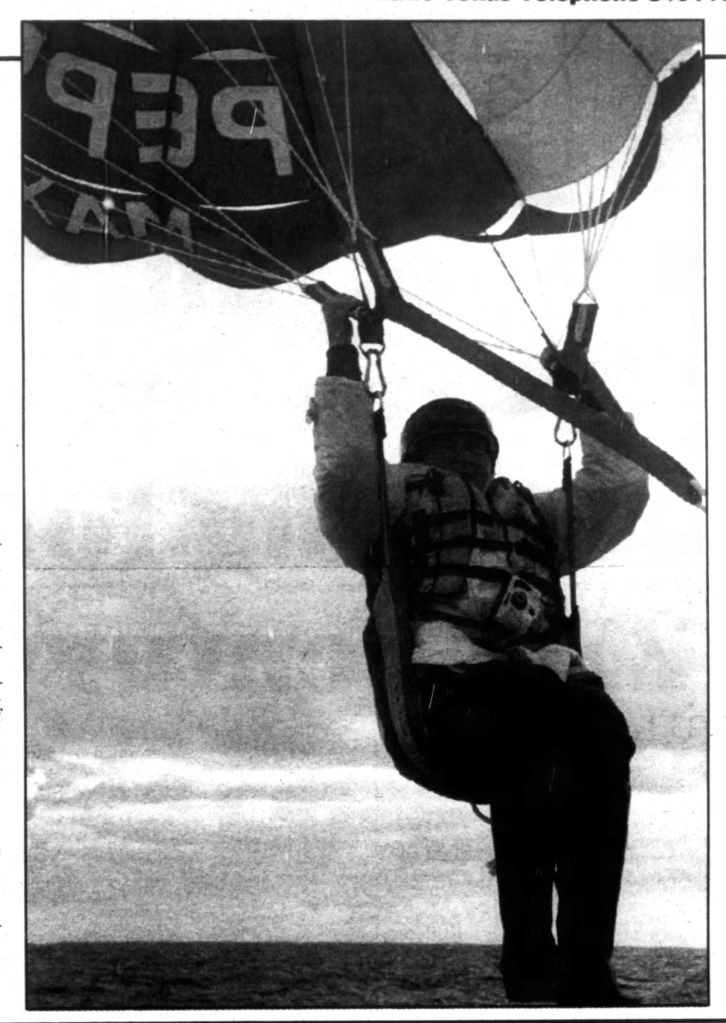
In 1994, aged 68, Joy parascended for charity, taking to the skies at 500 feet off the coast of Looe, for 25 minutes, raising £500 for the RAF Wings appeal, thus helping former service men and women and their dependents. She described the experience as exhilarating, reminding her of her sports gliding days.
Joy died at the family home in Looe, Cornwall in 2015, aged 80. She was another inspirational Heaton woman.
*Postscript
An unexpected additional connection to Heaton of Joy’s husband, Douglas Tamblin, came to light during the research. After WW2, Derek became a teacher and in 1962, he co-authored a school textbook entitled ‘Arithmetic Itself’ for the Junior Teach Yourself series. His fellow writer was Cambridge graduate Ernest William Burn (b 1898) who was brought up at 6 Ninth Avenue, Heaton. Perhaps this Heaton connection somehow brought Douglas and Joy together. Douglas predeceased Joy, dying, aged 80, in 2005.
Acknowledgements
Researched and written by Arthur Andrews of Heaton History Group.
Can You Help?
If you know more about Joy Tamblin or Ernest William Burn or have memories or photos to share, we’d love to hear from you. You can contact us either through this website by clicking on small speech bubble immediately below the article title or by emailing chris.jackson@heatonhistorygroup.org
Sources
Ancestry
BNA
Findmypast
YouGov
Hendon Air Museum
Who’s Who
First published by Heaton History Group on 29 November 2025.

