

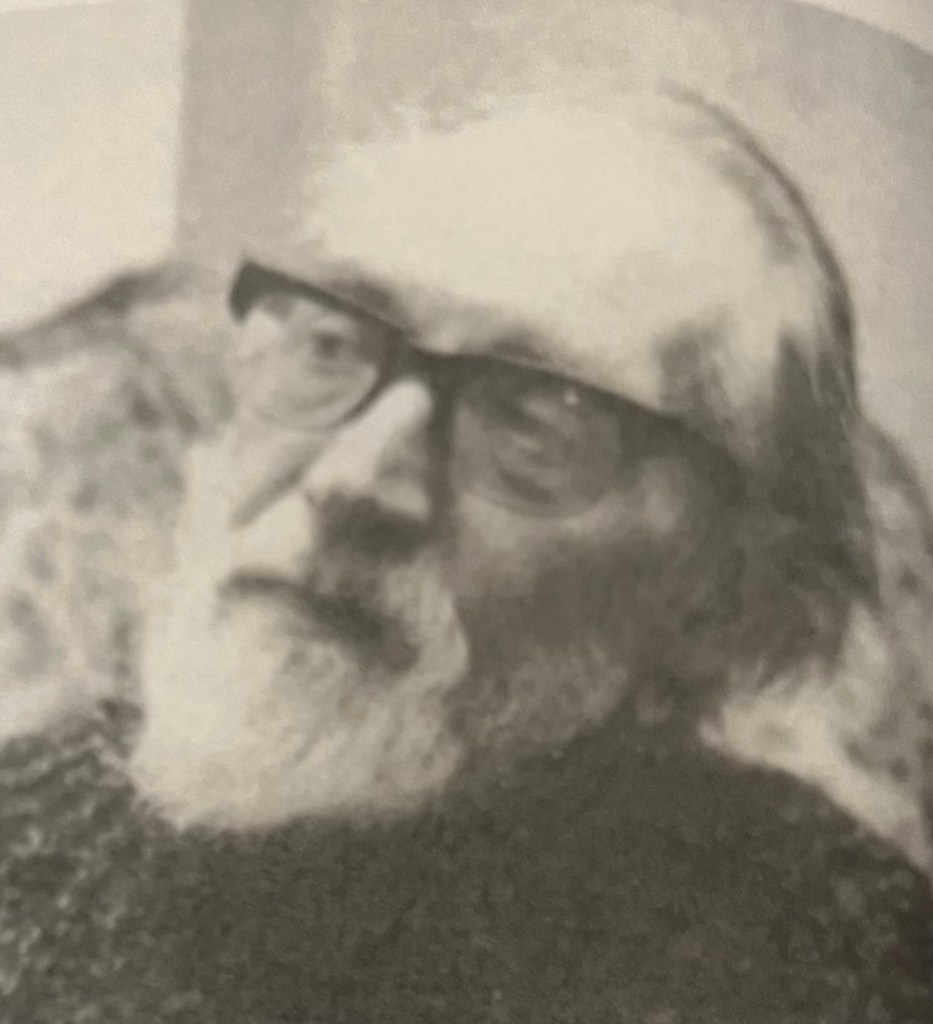
Brian Merrikin Hill was once described as ‘one of the most unjustifiably neglected poets of his age’. He spent four years as a pupil at Heaton Secondary School for Boys, a period which had a profound influence him as a person and a writer.
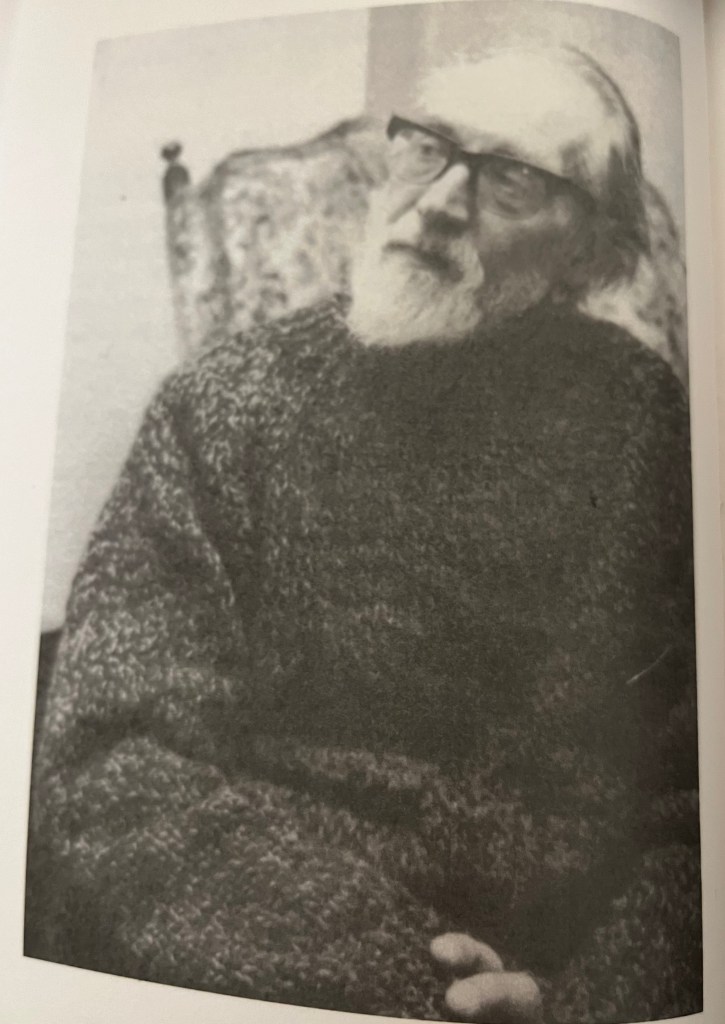
Peripatetic
Brian was born on 6 January 1917 in West Jesmond to Grace Margaret (nee Merrikin) and the Reverend William Penryn Hill. His father, a radical United Methodist Minister from Cornwall, was, at the time, Minister of Salem United Methodist Church in Sandyford.
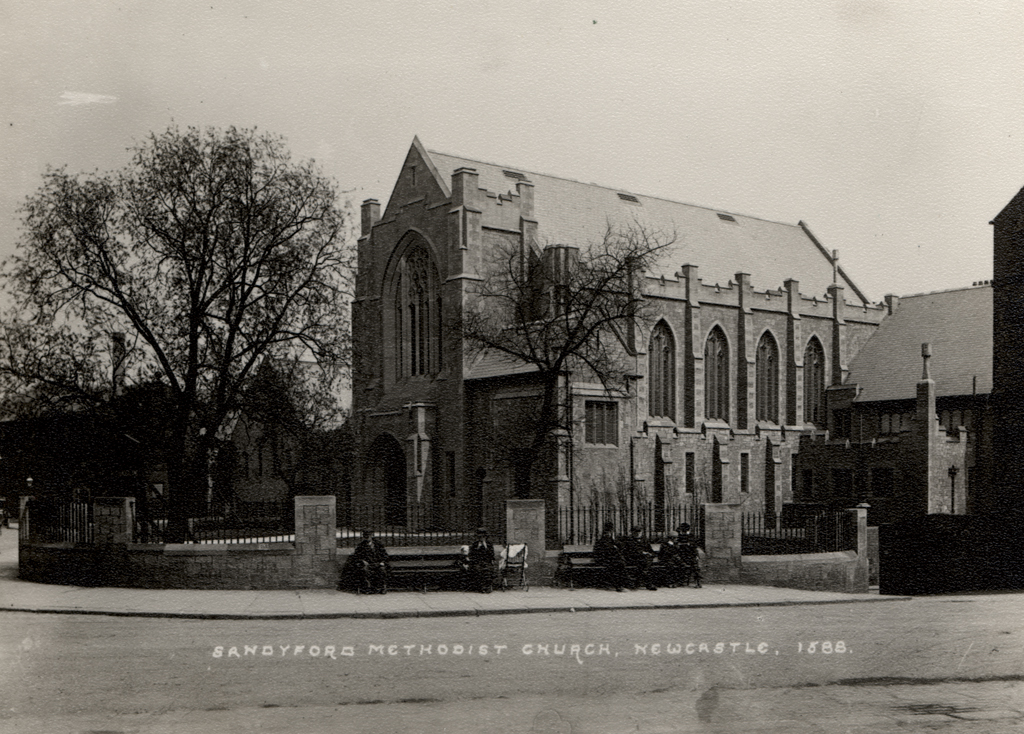
But ministers on the Methodist circuit moved frequently and by the time Brian was two, the family had relocated to Easington, County Durham.
Hill later wrote about his peripatetic childhood, mentioning some of the places the family lived:
‘My city childhood surprises friends, who remark that I seem alien to that nativity —
For I was twice born, though not in a Hindu sense:
After I had survived zeppelins in my first year
I was taken to Easington Colliery, Thorne and Belper—
and there I was a little child beginning
to emerge conscious in Worksop shortly
before my second birth in what I thought
was to be my own place. One dies and is reborn
many times, unless one is moribund from the start
(world conditioned) but certain births establish
what being rises in minor resurrections’.
(From ‘Conversational Elegies for a Tyneside Kid – Elegy III’)
Second Birth
However, in 1930, the family returned to Newcastle (perhaps the second birth he referred to above) and stayed for four years, during which time Brian attended Heaton Secondary School for Boys (now Jesmond Park Academy).

His contemporary and friend at school was Philip Yarrow, who became a professor of history and, luckily for us, referred to Brian in a 1999 article, ‘Some Literary Associations of Northumberland’ and the following year’s ‘At School between the Wars’ which he wrote for ‘Tyne and Tweed’, the journal of the Association of Local History Societies of Northumberland. These two articles gave us brief biographical information and led us to Brian’s own work in which Heaton and the surrounding area frequently featured.
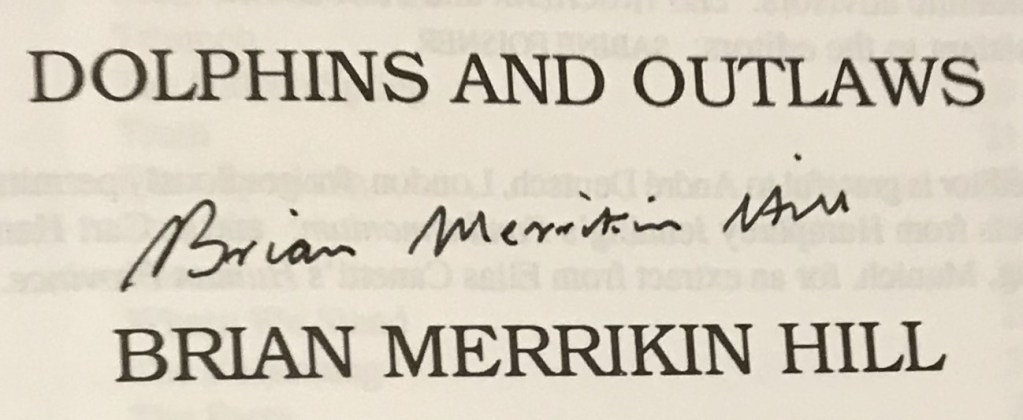
In the foreword to ‘Dolphins and Outlaws’ an anthology of his poetry published by the University of Salzburg, Hill credits Heaton Secondary School for nurturing his love of poetry:
‘What poetry could mean and be was established in my mind, I think, by the influence of Heaton Secondary School in Newcastle upon Tyne and the two teachers praised in the second “Conversational Elegy”, Ernest Dyer and Israel Simpson’.
In fact, although he refers to his Tyneside childhood and especially the poverty of Shieldfield and Byker in ’Elegy II’ of a series called ‘Conversational Elegies for a Tyneside Kid’ (which appears in ‘Dolphins and Outlaws’, it’s in ‘Elegy III’ that he refers to the Heaton teachers:
‘But two people have that immortality that lives in others
being transmitted
Israel Simpson revealed French clarity, order, purpose as a second medium for emotion and thought: none need be restricted to one manner of saying.”
Ernest Dyer brought drama into the mind and the mind into drama.’’
Elsewhere in the forward Hill said:
‘School days in Newcastle on Tyne made something that lasted long.’
Yarrow recalled Hill and himself being involved in a production of Karel Čapek’s ‘RUR’ (Rossum’s Universal Robots), a play most remembered for first introducing the word robot into the English language.
Hill also spoke of the influence of his father, who he described as a Methodist minister and early Christian socialist who worked for the Labour Party. He remembered the ‘sounds of the duplicators working through the night’ while his father was running an illegal newspaper during the General Strike of 1926.
The Hill family left Newcastle at the end of Brian’s Lower Sixth (what we would now call Year 12) at Heaton Secondary School for Boys. And he gives further credit for his development as a poet to his later teachers In Stourbridge.
Inspiring
On 12 October 1935 it was reported in the ‘Evesham Standard and West Midland Observer’ that Brian M Hill from Lye, (a mile from Stourbridge), had been awarded a major state scholarship to go to Oxford University’s St Catherine’s College. He graduated from there in 1939 with a First in English.
No sooner had he received his degree, than war was declared. We know that at this point, Hill had returned to the family home which was now in Sheringham, Norfolk while he found work. During the war, he was a conscientious objector.
He soon became a teacher spending six years at the independent Abbotsholme School, a progressive independent school on the Derbyshire – Staffordshire border. By the time he left in 1948, Hill was head of the French department. He was already a noteworthy poet. ‘Eighteen Years’ was published in 1947.
His next post was at Wennington School in North Yorkshire, as a teacher of English and Latin. This was another progressive school, with never more than 130 pupils. K E Smith, Hill’s obituary writer, wrote:
‘The school, with its combination of shared, communal effort and exploratory educational methods, its mix of children from liberal, middle-class homes and children sent by local authorities because of family or behavioural problems, proved an ideal setting for him. More significantly, he became known as an inspiring teacher, one who was spoken of as enabling his students to believe in their own efforts and as opening many literary doors to them.’
Hill became the deputy to Kenneth Barnes who, with his wife had founded the school. On Barnes’ retirement in 1968, Hill became headmaster. However, by the early 1970s the school ran into financial difficulties and, in 1973, Hill, perhaps more suited to teaching than management, resigned.
Second Flowering
After his retirement, Hill was able to devote more time to his poetry and he joined a group called Pennine Poets, which had been established in 1966 and is still going strong today.

He, the group and the magazine seems to have gone from success to success. Hill did not only write, he also mentored younger poets such as Pauline Kirk who went on to write a short biography of him.
In 1973, the group began to publish a magazine, ‘Pennine Platform’, with the aim of promoting poetry. In 1977, Hill became its editor.
In 1979 the International Poetry Society published a selection of his work in its journal ‘Orbis’. Over the next two decades, Hill had a number of books of poetry published, including:
‘Two Poems of Pilgrimage’ 1977
‘Wakeful in the Sleep of Time’; Taxis Press, 1984
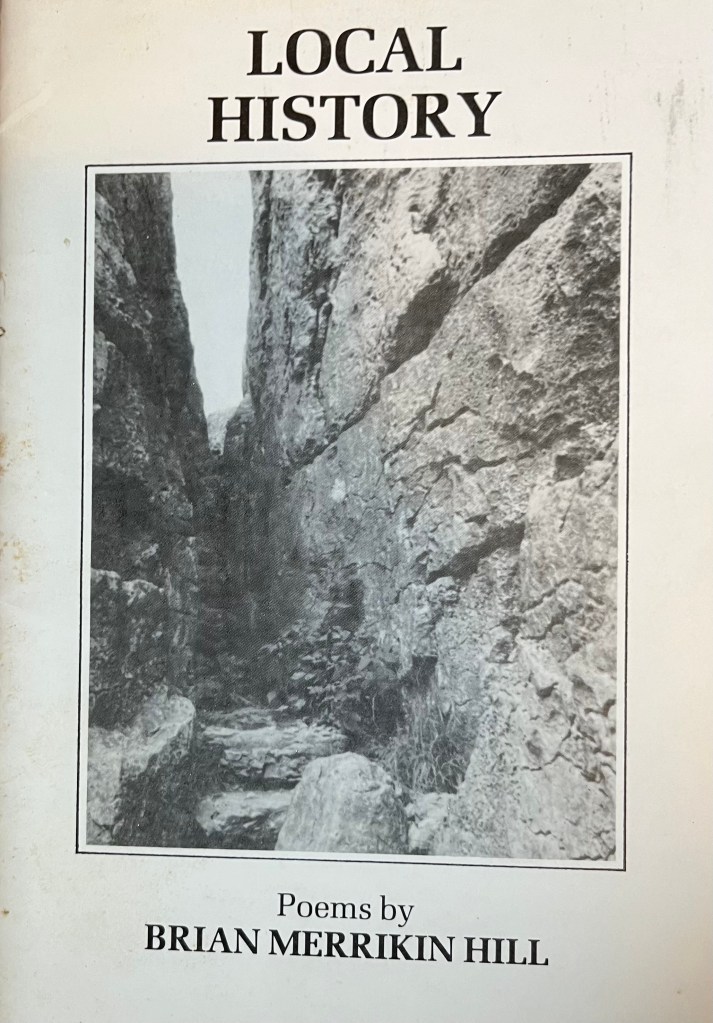
‘Local History’ ; Littlewood Press, 1985
‘The European Letters’; Taxes Press, 1987
‘Dolphins and Outlaws’ and ‘With Planetary Eyes’ the University of Salzburg, 1993
Hill achieved second place in the Scottish National Open Poetry Competition in 1987 and in 1988 was awarded first prize with his poem ‘The Make-Up Box’. There had been 5,200 entries. He received The MacDiarmid Trophy and a prize of £100. He went on to win the prize again in 1990 with ‘The Human Variations’.
Local
Hill continued to write about growing up in Newcastle, including in this poem, ‘Bridge over the Ouseburn, Jesmond Dene’:
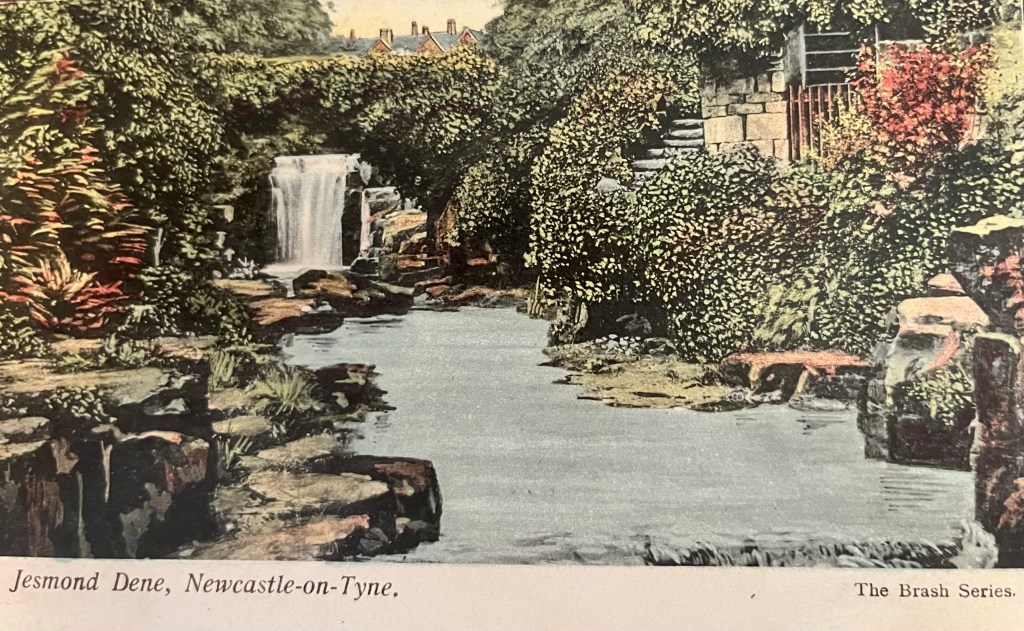
‘The swallows have flown through the bright sunshine
away from the midnight frosts, since earth and the planets turn
cyclic like Ouseburn water lovely over stone
accidentally as it falls through slums to the Tyne
and flows to the sea to evaporate into rain
and glint incidentally on haphazard rocks again.
The swallows come back. The girls and I are gone.
No one remembers Freda, Brenda, Betty
as their limbs and spirit felt. In records of the city
deeds or deaths may be dustily filed. But in maps
that accurately trace rivers no water flashes,
lakes do not ripple, there are no shadows. Cups
once emptied never hold the same wine again: blushes
recur but are never that first complicity
with you, fecund earth, in fortuitous generosity.
We were briefly your voices, were briefly the ear
that listened, not always attentively, to what
you were always saying and will every cyclic year
whisper, shout, laugh or lament when we are not.
Let others who, feeling, speak know you also hear.
Brian Merrikin Hill died on 19 February 1997 in Harrogate.
Appreciation
It’s fair to say that Hill is not well known to the general public and the above works are all out of print (although secondhand copies can sometimes be found). However, he was and is well thought of in the literary world as evidenced by his awards, publications and comments made by fellow poets such as Kathleen Raine, who said that he was ‘a poet whose excellence has become clear over the years of his unswerving devotion to poetry’ and David Gascoyne who called him ‘one of the most unjustifiably neglected poets of his age’.
Hill’s biographer, Pauline Kirk, referred to his interest in local and family history. Many of his poems, including those quoted above, reflect this, as does the title of one of his collections.
He deserves to be remembered as part of ours.
Can You Help?
If you know more about Brian Merrikin Hill or have photos or memories to share, we’d love to hear from you. You can contact us either through this website by clicking on the small speech bubble immediately below the article title or by emailing chris.jackson@heatonhistorygroup.org
Acknowledgements
Researched and written by Arthur Andrews.
Sources
‘Brian Merrikin Hill: poet and mentor’ by Pauline Kirk; Fighting Cock Press, 1999
‘Dolphins and Outlaws’ / Brian Merrikin Hill; University of Salzburg, 1993
‘Fighting Cocks: forty years of the Pennine Poets – Spirit and Emotion’ by Mabel Ferrett, edited by Pauline Kirk; Fighting Cock Press, 2006
‘Local History’ / Brian Merrikin Smith; Littlewood Press, 1985
‘Obituary: Brian Merrikin Hill’ / K E Smith in the ‘Independent’ 20 March 1997
‘Tyne and Tweed’ 1999 and 2000
plus Ancestry, British Newspaper Archive, FindMyPast and other online sources.
First published 26 August 2024


I’m guessing that his appearance in Capek’s play Rossum’s Universal Robits must have been at the People’s Theatre, which would probably be the only company to have performed such a play. It was staged twice by the People’s Theatre (formerly known in its early days as the Clarion Dramatic Society):
February 1927 – which would have been at the old Royal Arcade on Pilgrim Street
March 1930 – which would have been performed after the theatre moved to Rye Hill.
Interesting! I had assumed the play was put on at school but you may well be right.