

Does anyone remember The Metal Box Company works near Heaton Junction?
A Bit of History
Nationally the company dates back to at least 1810, although some of its constituent companies predate that, including Hudson Scott and Sons of Carlisle and Newcastle, acquired by Metal Box in 1921 and which is said to have been founded in 1799.
However it was a Heaton firm, I A Hodgson, that led to the company’s presence on Chillingham Road. I A Hodgson, owned by Irvine Anthony Hodgson, was originally a manufacturer of cork products but by 1922 described itself as a ‘decorated tin manufacturer’.

Metal Box seems to have acquired the company in 1924, although it continued to trade under its original name until WW2. Irvine, the son of a butcher from County Durham, had died in 1931, leaving over £24,000 in his will.
Nationally, in 1932, Metal Box described itself as a ‘maker of plain and decorated tins and tins for fruit and vegetables’ At this point, fruit and vegetable canning represented only 20% of its business, although that was expected to grow. In the mid 1930s it made the first British beer cans.
But it wasn’t all about tin cans. During WW2, its products included:
‘140 million metal parts for respirators, 200 million items for precautions against gas attacks, 410 million machine gun belt clips, 1.5 million assembled units for anti-aircraft defence, mines, grenades, bomb tail fins, jerrican closures and water sterilisation kits, many different types of food packing including 5000 million cans, as well as operating agency factories for the government making gliders, production of fuses and repair of aero engines‘
However, it described its Heaton Junction enterprise as a ‘tin box manufacturer’ into the 1950s. Hopefully someone who worked there will remember its range of products and let us know.
By 1961,Metal Box boasted more than 25,000 employees in total in ten subsidiary and 13 associated companies and it soon became the largest user of tinplate in Britain, producing 77% of the metal cans in the UK.
But by 1970, the Metal Box name had disappeared from local trade directories and telephone books. There is a photo in Tyne and Wear Archives (not yet seen by us) of the premises in 1976 before work began on the Metro .
Globally, Metal Box is now part of the giant American multinational conglomerate, Honeywell.
But what of Metal Box in Heaton?
Mrs Anne Fletcher remembers:
‘It was situated at Heaton Junction at the top of Chillingham Road. The premises are long gone now and the site appears to be part of the environs of the Metro.

My first job after leaving Heaton High school in 1956 was in the offices. I’d been looking for a job when I received a telegram from the firm asking me to contact them. Not many people had ‘phones then!
I duly began my working life as a junior telephonist/receptionist at the weekly wage of £3-12-6d. This enabled me to pay my mam for my keep, go dancing at the Oxfordballroom in Newcastle and buy a few treats.
I walked there and back, lunchtimes included. My route went over the skew bridge, passing the stone wall which bordered the railway shunting yard. I remember there were huge advertising hoardings behind the wall. I passed my old school, then on reaching the corner of Rothbury Terrace, passed the dark blue Police box (like “Dr Who”) and so home to Warton Terrace.
My new duties included greeting visitors and learning to operate the switchboard with its plugs and extensions connecting callers to the various departments. I was shown how to correctly wrap sample tins for posting and I would take the franking machine up to the post office at the top of Heaton Road. I had to practise typing as I had to attend weekly classes in Newcastle.
In Reception it was fascinating to watch the large Telex machine spring to life, chattering, with typed pages magically appearing. I learned how the typists’ Dictaphone wax cylinders were cleaned on a special machine, after which they were redistributed.
Having to walk through the factory one day was a bit daunting as it was of course a very busy and noisy place. It was all new and interesting though.
I moved on to the accounts department and used a large calculator. Others worked as comptometer operators. I eventually decided to go to the Ministry of Pensions and National Insurance, as it then was, at Longbenton. I enjoyed my time at Metal Box though. It had given me a good introduction to working life.’
Your Memories
If you have memories, information or photographs of Metal Box, which you’d like to share, please either upload them to this website by clicking on the link immediately below the article title or email them to chris.jackson@heatonhistorygroup.org We’d love to hear your recollections of other notable Heaton workplaces too.
Acknowledgements
Many thanks to Mrs Fletcher for her memories and to Ian Clough, who found the advert for I A Hodgson & Co Ltd.
The photo is taken from ‘Heaton: from farms to foundries’ by Alan Morgan; Tyne Bridge Publishing, 2012. Thank you to Newcastle Libraries in whose collection the original can be found.
Details of Metal Box’s history are from ‘Grace’s Guide to British Industrial History’ http://www.gracesguide.co.uk/Metal_Box_Co


I never really grasped the concept of a ‘metal box’ company. I was permanently aware of its presence, of course, but the idea that a company could exist that simply made metal boxes was a leap too far for my comprehension. I suppose, if I’d asked for an explanation, and been told they made cake-tins and biscuit-tins and tin cans, et al, I would have understood; but I insisted upon enduring this mysterious concept. The problem, of course, was in calling it metal – instead of tin; metal to me meant iron or steel (aluminium didn’t exist back then, as far as I knew) and who wanted an iron box? ‘The Tin Box Company’… now that would have made perfect sense: everyone needed tin boxes.
It did what it said on the tin!
Until it diversified anyway. They’d have needed a big tin to get that lot on!
Had this company any connection with the Smith family from Ringtons and northern coachbuilders?
Not as far as we know, Florence. Do you think it might be?
While being an avid British comic collector from Byker originally, I do know that the Metal Box Co. of Carlisle did diversify, at least in the late 40’s early 50’s into making lightweight tinplate signs for newsagents walls advertising comics of the day. I do have a photo of a couple I could post which might bring back memories but doesn’t look like I can attach one to this post?
Interesting. If you’d like to email one or two to chris.jackson@heatonhidtorygroup.org, I can add them to the article.
My father, Lennox Golding Bennington, worked for Metal Box from just before WW2 TO HIS EARLY RETIREMENT IN THE EARLY 1970’S AT Palmers Green, Chequers Works, North Circular Road, N13. in the end in a senior position. my interest is his late call up to the armed forces (RAF) I presumed he was in a reserved occupation as I had seen him in a home guard unit photo. Could you confirm this please, or tell me who could. I have his RAF service record for when he returned from Ceylon in 1946. Any information as to what Palmers Green was making in war time would be of interest. He died while living with us in Western Australia.
I’m sorry, John, we are a local history group from Newcastle upon Tyne and so haven’t done any research on Palmers Green. Good luck.
James Porter emailed to say:
‘I started my apprenticeship there in 1966 . After a number of month’s shadowing one of the engineers in the toolroom I started a rotation of the different departments . All the apprentices went through this . Factory maintenance development drawing office then back to the toolroom . They’re shown repair and sharpening of the press tools . Once I was able to complete the work to the engineers satisfaction I was then allowed to do the jobs myself . About 1968 the factory received new equipment from America which sped up production . The outer wall of the factory was bulging due to the weight of the presses on the upper floor and the vibration. Pluse the factory could not be expanded due to the building’s around it the factory was closed. We apprentices had to relocate to Carlisle to complete our apprenticeship any members of staff were offered the chance to move there or redundancy.’
My dad worked as a storeman for many years at Metal Box, until they moved away from Heaton. He often talked about Jacky Hodgson.
@ John Bennington
John ~ Your father would have known knew my Dad, Leslie, from their days at Palmers Green. I know a little bit about the history of Chequers Way so feel free to PM me if you would like to know.
pull-rage-reload@duck.com
But yes, many would have been considered to be in a reserved occupation as MB Palmers Green was a fully-fledged munitions factory. Most of the Mk 36 hand grenades used by our troops were made there.
I was toolroom inspector, taking over from Billy Grubb who had worked there for many years (from 1st war.) I left in 1966 and moved away ( Canada) and lived on Meldon Tce. Cheers Bob.
Email from Yvonne Shannon (The photo has been added to the end of the article)
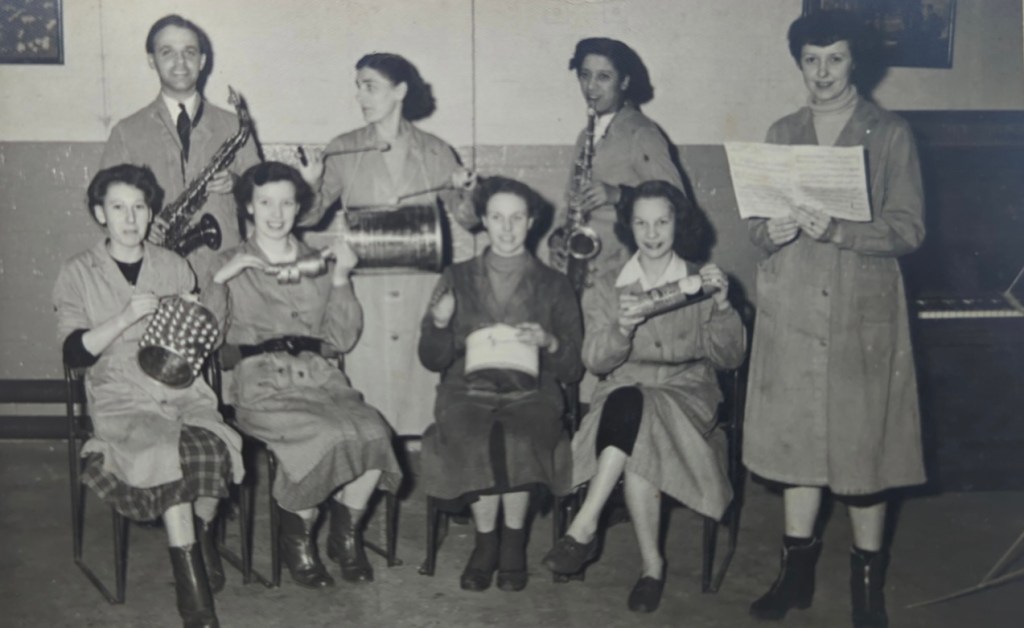
I was reading about the Metal Box Factory and thought you might like to have this photograph of the Metal Box Band.
My Mother Doreen Shannon (Pickering as she was on the photo) started work there at age 15. The wages were 30 shillings a week or £1. 50 in today’s currency. This photograph was taken in 1952 when she and her best friend Joan Linton (married name Nicholson ) were 18 years old. Mam is 92 years old now and fondly remembers her time at the factory she really liked working there. At the time they started the band there was a competition held at lunchtime which ran for only a short period of time, about three or four weeks she thinks, they were winners one week but lost out to other competitors after that. The song they were playing was ‘Brazil’. Other acts included dancers, singers and one woman who Mam particularly remembers who sang in the style of Al Jolson.
Names of the people in the photo.
Betty Hudspeth who is standing and holding the music, Betty was the singer and was very good. Mam is sitting next to her playing a ‘Dunlop Tennis Ball Tin’ filled with metal caps. In the middle of the photo sitting next to Mam is Rita Buxxio, and next to her is Mam’s lifelong best friend Joan Linton playing a ‘string threaded with metal rings’. Molly Lake is sitting next to Joan at the end of the front row. Behind Molly and playing the sax is a very nice man but Mam cant recall his name, he was visiting the factory from London and worked in Quality Control. Standing in the middle is Lizzie Dunwoody, and next to her is Edith with the saxophone. Mam recalls that Edith wrote to George Evans the bandleader from the Oxford and then went for saxophone lessons.
Mam left when she was first married but returned to work part time at the Metal Box in the 1960’s. She was there until just before production moved to Carlilse. At the point she left her wages were £7 a week.
My dad worked at the Heaton factory. I don’t know when he started there but he was a press tool maker who had learned his trade at CA Parsons. He probably started at Metal Box in the tool room but ended up as Quality Control Manager.
I remember as a kid going to some kind of open day and wondering how anyone could work in all that noise.
When the Heaton plant closed we moved to Carlisle along with others.
There was Peter Keys, Frank Rutter, Jock Nickel and others I Can’t remember. The Heaton general manager was called Armstrong, he didn’t make the move. After two years my dad found that he couldn’t live without the Tyne and the sea and Newcastle, so we left Carlisle and moved to Tynemouth.
My dad was George Pinchard. I wonder if anyone remembers him, though his generation will all be gone now. He said that his time at Heaton were the Happiest years of his life.