

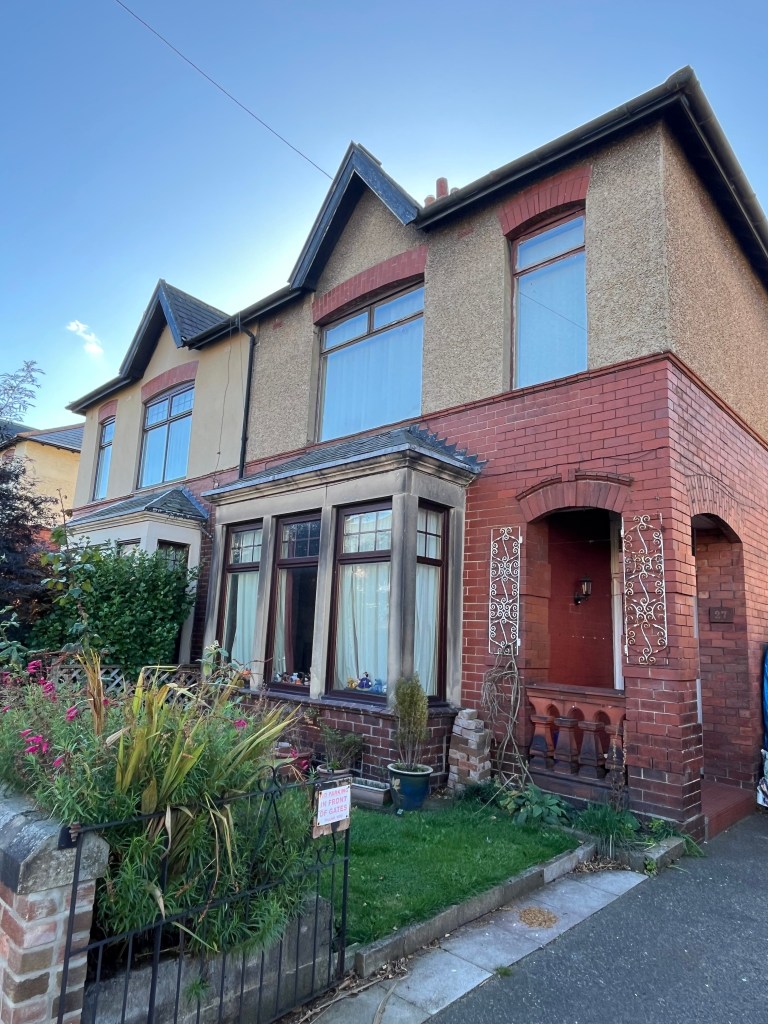
We know a lot about the odd-numbered houses on Coquet Terrace, the handsome semi-detached residences with brick porches: who designed and built them; where the bricks were sourced from; the costs incurred and, perhaps more interestingly, who some of the earliest residents were.


Much of this information comes as a result of the houses being included in a 1905 publication ‘Modern Housing in Town and Country’ where they are described as ‘Cottages at Heaton: semi-detached villas….built by Mr W Thompson‘ and illustrated as above. The architects were named as ‘Messrs White and Stephenson of Newcastle-on-Tyne’. We’ve been able to supplement what the book tells us with data from historic records.
Costs
The costings are detailed in the book. Current residents may be interested to hear that at the front ‘Accrington first quality red pressed facing bricks at 89s per 1,000 including delivery‘ were used, whereas at the back and sides cheaper Wallsend Atlas bricks (’45s per 1,000′) sufficed and inside ‘common bricks’ at 27s per 1,000 were considered good enough. The provenance of the roof slate isn’t given but it cost 3s 3d per yard. The skilled tradesmen who worked on the construction (bricklayers, masons, plasterers, plumbers and painters) earned 10d an hour and labourers 7d.
It was calculated that the price per cubic foot of the house was a little under 5d and the number of cubic feet in each house was ‘about 19,693’. Accordingly, the actual cost of each house ‘including flagging, boundary walls etc’ was £420, without taking into account count the costs of the land, the main sewer and street making. The land cost £122 10s per house (10s per yard), the sewer £5 and street making £15. The overall cost was given as £562.10.
Architects
White and Stephenson, the architects, had premises at 59 Grey Street (now part of a shop selling fine art).
In 1901, 24 year old Lancastrian, Samuel James Stephenson, was living in South Shields with his schoolmaster father, his mother and an older sister. He had been articled to local architect, Joseph Stout, but was now an assistant to William Hope, whose Heaton buildings include the former Methodist Church on Heaton Road and some of the large villas on that road including Craigielea and Coquet Villa. It was at this practice that Stephenson probably met Thomas White, with whom he went into partnership in 1903.
Royal Institute of British Architects (RIBA) records show that Stephenson was responsible for the design of many cinemas. They included the Heaton Electric, a conversion from an unoccupied private house, Jesmond Picture House and the Raby in Byker. He also designed large warehouses and factories all over the country for Ringtons as well as ‘many hospitals, factories, garages, social clubs, miners’ welfares, churches, Masonic temples, multiple stores and large housing estates all over Northumberland and Durham’.
By 1911, Stephenson was living in Whickham with his wife of seven years and their four children and a servant. The family were still there at the time of his death in 1940.
Thomas Killingworth White was born in the same month as Samuel Stephenson, February 1877. Despite his middle name, he wasn’t a local man. He and his siblings were born in Islington, which was at that time in Middlesex, where his father and grandfather, both also called Thomas, were chemical manufacturers but, by the age of four, he was living in Killingworth House, Longbenton, a large residence now long demolished, with his grandfather, Thomas Reynolds White, a chemical manufacturer and landowner, his parents and siblings plus several aunts and uncles. It’s unclear why the extended family relocated. It may have been for commercial reasons but the unusual wording on Thomas Reynold’s gravestone in Killingworth might suggest another reason.

Was Killingworth House perhaps inherited from his mother’s family? Or was that just a myth that Thomas Reynold wanted to perpetuate?
Either way, by 1901, aged 24, Thomas Killingworth White was living with his widowed mother and two sisters in Newcastle. He was articled to William Hope but soon he and Samuel Stephenson set up in partnership. Alongside his professional practice, from 1907 White, now living in Forest Hall, served as a county councillor for Killingworth.
In 1911, he was living in Benton with his wife of nine years and their three children, the youngest of whom was just eleven days old, plus a nurse and a servant. He served in WW1, originally as a private with the Royal Engineers, but it was recorded that he had health issues. By 1926, although still a member of the Northern Architectural Association, he was no longer registered with RIBA, and specific information on his architectural achievements is scant. The Whites had many addresses over the years. In 1921, they were recorded as lodging in the west end. And in 1939, Thomas alone was in Jesmond. He died in 1943, aged 66.
The Builder
The builder is named in the book as William Thompson, who was from Cumberland.
In 1891, William was in Workington with his wife Isabella and two very young children and employed as a joiner. By 1901, the family had moved to Tyneside, William had his own business and they were living opposite Richardson Dees Park in Wallsend with a servant. They seemed to be upwardly mobile.
As was common at the time, while the building work was underway, they lived in various houses on the terrace, but in 1911, the Thompsons were occupying number 49 a larger house on the corner. The 45 year old building contractor’s family comprised his wife, Isabella and three sons: 21 year old Joseph, who was working in insurance: James, whose occupation is given on the census form as ‘Worker with father’ and 17 year old William Harold, who was an insurance clerk.
We know that William worked with the architects, White and Stephenson, on a number of projects including Heaton Electric Palace and other cinemas. But he worked with other architects too.
By 1921, the Thompsons had moved to Craigielea, the imposing villa at 276 Heaton Road designed by William Hope, which we have already written about on this site. It appears that Thompson may have owned it for almost 20 years, as a builder of the same name, then living in Simonside Terrace, bought three adjacent plots of land from William Watson Armstrong in 1902. Craigielea was built by the firm of William Hope and his partner, Joseph Maxwell.
Craigielea was rented out to a series of interesting occupants for almost 20 years until sometime before census night 1921, William, Isabella, their youngest son William Harold, (now working with his father), daughter in law, Lena, and young grandson, Clifton Cook, moved in. The firm’s premises were given on the census form as being in Ayton Street, which is in Byker.
Adverts
The first mention of the houses on Coquet Terrace in the local press was on 3 March 1905 when, after a meeting of the Town Improvement Committee, it was reported that plans had been passed for the erection of 22 houses on Coquet Terrace on behalf of Lord Armstrong. In 1906, there was an advert for an apprentice plasterer ‘Apply Thompson’s Villas, Coquet Terrace’.
In February 1906 came the first evidence that some of the houses were occupied when Miss E Pearce, ‘late of Darlington’, advertised her services as a teacher of violin and piano from her new home at number 3.
In June of that year ‘board-residence for one gentleman or two friends’ was on offer at number 7.
Occupants
There is only space here to mention a small percentage of the occupants of the ‘odd side’ of Coquet Terrace and we have concentrated on the the first 15 years or so, but they’ll give a flavour of its character and included some noteworthy people.
The first known occupant of number one, for example, was J Thompson, a butcher, and there were other successful small businessmen such as John M Thompson, a tailor, at number 21 (Was the number of Thompsons a coincidence or were they relatives of William the builder?); Edward Parker, another butcher, and Ernest Harmer, a boot dealer at 27; John Hennell, a confectioner, at 43 and Alexander Bruce, another tailor, at 45.
There were also lots of clerks and salesmen / commercial travellers but most of the ‘heads of household’ were professionals. William Jennens Hackett, who was living at number 25 at the time of the 1921 census, had been awarded the MBE in 1918. He had been Honorary Secretary of the Newcastle upon Tyne-War Savings Committee. Engineers were particularly well-represented and included, at number 1 after Thompson the butcher, William Middleton, assistant superintendent of the Newcastle and District Lighting Company; marine engineers Edward Pearce at no 3, John Catto at no 15, Robert Sharp at 21 and H N Evans at 23, which is reflective of Tyneside’s economy at the time.
Eminent
A number of the early occupants were of national and even international importance in their fields.
A notable occupant of number 25 was Edgar Mark Eden, who was a metrologist (that is is a person who studies and practises the science of measurement). He lived on the terrace between about 1909 and 1915 while first working as an engineer and then lecturing in mechanical engineering at Armstrong College (now Newcastle University). But during the war, he was recruited by the National Physical Laboratory and developed much improved devices for taking measurements first of all in the manufacture of munitions and then across industry. The importance of his work is shown by the fact that many of his inventions are in the collection of the Science Museum in London, some of them pictured on the museum’s website. An obituary writer said ‘In the list of those who have led the post-war reconstruction of our industries, Eden’s name should stand high’. The obituary in ‘Nature’ also gives us a feel for the man outside work, mentioning his love of wild flowers and Mozart and his genial nature.
Philip Vassar Hunter, who came from Norfolk, lived at no 41 from around 1909 to 1917, while working for electrical engineering company Merz and McLellan, who, during the war, ‘loaned’ him to the experiments and research section of the anti-submarine division of the Naval Staff as Engineering Director. Here his important work aimed at protecting British ships from enemy submarines led to the award of a CBE. During the Second World War, Hunter invented buoyant cable, which ‘significantly contributed to the defeat of the magnetic mine’. In 1933, he held the position of president of the Institution of Electrical Engineers, of which he became an honorary fellow in 1951 recognised for his ‘outstanding service to the electrical industry and to the institution’.
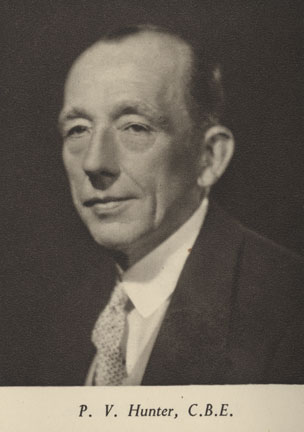
But Philip Vassar Hunter also had a sporting claim to fame. He was an ice hockey enthusiast who from 1934 to 1958 served as president of the British Ice Hockey Association. Under his leadership, the Great Britain ice hockey team achieved the remarkable feat of winning the gold medal at the 1936 Winter Olympics. Does he count as Heaton’s first Winter Olympian?
A photograph of Hunter is held by the National Portrait Gallery. He even has an entry in ‘Kiddle‘, an online encyclopedia for children.
But perhaps the most remarkable man we found to have lived on Coquet Terrace was Horace Short, who lived at no 5.
Horace Leonard Short was born on 2 July 1872 in Chilton, County Durham while his father was working as colliery manager there. Later, at school in Derbyshire, he was recognised as being exceptionally clever, especially in the field of mathematics. He also had a sense of adventure: at the age of 18, he worked his passage to Australia and then to Mexico, where he developed machinery which revolutionised the silver mining industry there. On the death of his father in 1893, Horace returned home to help his mother and siblings.
While his brothers, Oswald and Eustace, established a business in Battersea manufacturing hot air balloons, Eustace concentrated on the interest in air compression that he’d developed in Mexico, particularly as applied to acoustics. In 1898, he patented the design for the ‘Gouraphone’, a loudspeaker driven by compressed air, which improved on an earlier design by Thomas Edison. During the 1900 Paris Exposition, he demonstrated it from Gustav Eiffel’s room at the top of the Eiffel Tower from where it was apparently heard all over the city. Short believed the gouraphone could be a game-changer as a communications device on the battlefield in particular.

It was this invention that led Horace Short to come to Tyneside. Charles Parsons also had an interest in acoustics and was working on similar ideas to Short. When Parsons tried to take out a patent for his ‘Auxetophone’ a few years later, he was contacted by Short pointing out that he’d had the idea first. Parsons bought the rights to Short’s patent for £700 plus £400 a year payable for four years and offered him a job at the Heaton works to develop the concept further. Hence, Short was living in Coquet Terrace from 1906. He also lived on Chillingham Road for a spell.
Parsons wrote later that the pair spent a lot of time and energy developing the design of the auxetophone for use in music and said that an auxetophone valve was used in double basses at a concert at the Proms around this time but met with resistance from musicians. He further said that Horace was then employed on other work at Heaton, ‘including experimental attempts to make diamonds’.
In the meantime, however, Eustace and Oswald, Horace’s brothers, had realised that the future of aviation lay not in balloons but in heavier than air machines ie aeroplanes and they set up a company in Battersea in order to build them. They were struggling, however, and realised that they needed Horace’s genius to make the firm a success. Horace joined his brothers back down south and in 1908 Short Brothers and the world’s first purpose built aircraft factory were born.
In 1909 Charles Rolls (co founder of Rolls Royce and another aviation pioneer) introduced the Shorts to the Wright Brothers. This photograph of aviation pioneers including the Wright brothers, the Short brothers and Charles Rolls was taken on 4 May 1909 on the Isle of Sheppey near the Short brothers’ factory. In fact, everyone in the photograph played an important role in the development of flight, except perhaps W J Lockyer who was an eminent astronomer and meteorologist. Just over a year later, Charles Rolls became the first Briton to be killed in a heavier than air aircraft in the first such accident on British soil.
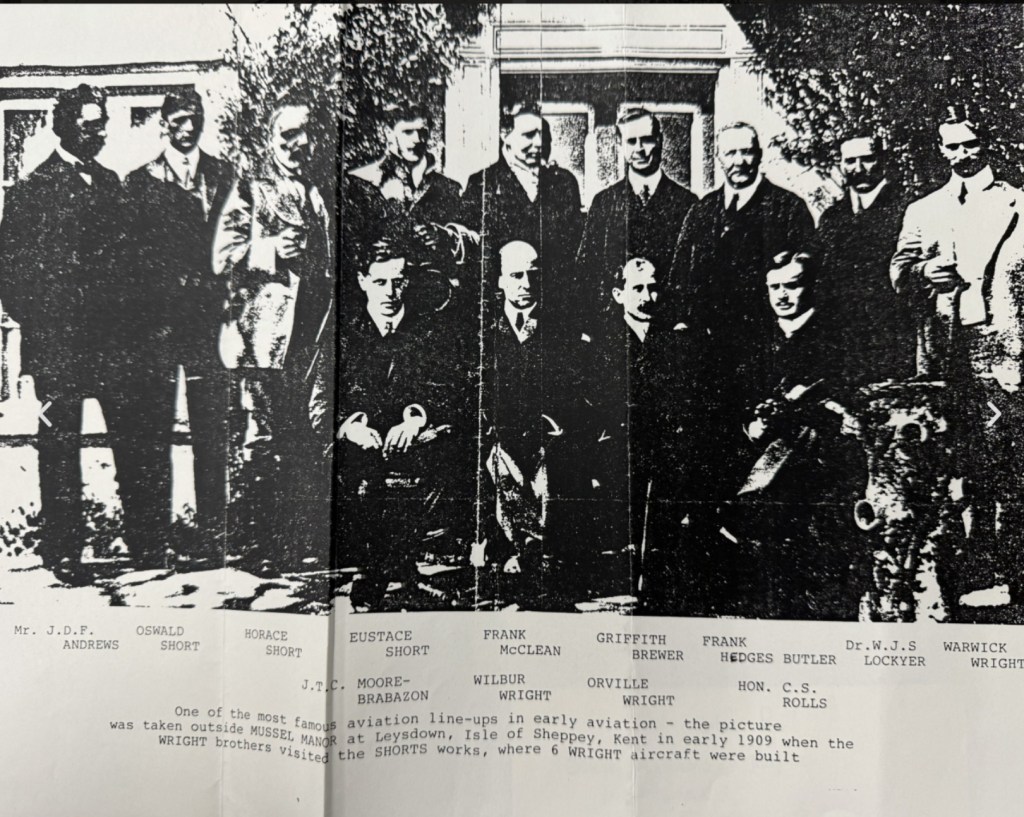
The brothers built aircraft firstly for Charles Rolls and then, when they took an order to build six aircraft to the Wright brothers’ specification, Short Brothers became the first aircraft manufacturing company in the world and built the Royal Navy’s first planes in 1911. Horace was the company’s chief designer. He designed and the company produced the world’s first seaplane in 1912. His hydroplane could not only take off and land on water but it could also accommodate three passengers. Horace died tragically early in 1917 aged 45.
This is an extract from Horace’s obituary in ‘The Aeronautical Journal’:
‘In any other country than this, such a man would have found his name a household word and his story would have been one of the most familiar among all classes of the community. What the British Navy owes to him it is impossible adequately to state. The lapse of years will cause his work to emerge in true perspective.’
Short Brothers relocated to Belfast in 1948. It is now owned by Spirit Aerosystems and makes aircraft components for companies like Boeing, Rolls Royce and General Electric.
An auxetophone was in use at Parsons’ Works in Heaton into the 1930s.
Women
Everyone described in this article so far has been a man but the women of Coquet Terrace deserve a mention too. It is more difficult to follow their lives through historical records but what we have discovered shows that many of the women of Coquet Terrace were economically active and played important roles outside the home as well as within it.
As we have seen, Ethel Jane Pearce, who was the daughter of Edward and Marie, the first occupants of no 3, was musical. She advertised her services as a teacher of violin and piano from 1906 when she was around 19 years old. In 1911, 19 year old Annie Crawforth at no 7 was a milliner, working from home; Joan Davidson, who was married but whose husband wasn’t at home on census nights in either 1901 or 1911, probably had to earn a living. She was running a boarding house at no 11 – boarding there on census night in 1911 was Margaret L Turnbull, a head teacher; 39 year old Kate Hobson, the head of household at no 17, recorded on the census form that she had ‘private means’ as did her 30 year old sister, Alice Maud. From 1917, Sarah Jane Childs, a teacher who went on to train teachers, lived at no 25 and there was a trainee teacher, Norah Smart, living at 27 along with her younger sister, Carmen, who was a typist in a lawyer’s office. Yet another teacher, 23 year old Ethelberta Noble lived with her parents and siblings at no 33.
Perhaps the most notable woman on the terrace lived at no 31 from around 1913 to 1919. Mary Moberly was born in Manchester in 1852. She was the daughter of Rev Charles Edward Moberly, a clergyman and assistant master at Rugby School and his wife Catherine. Mary was accepted at Newnham College, Cambridge where she was awarded a first class pass (There were no degrees for women then) in the Moral Science Tripos. She began a teaching career in Notting Hill and then Tunbridge Wells and, in 1889, when, it is said, she discovered that her neighbours, a coal merchant and a chimney sweep, were able to vote but she wasn’t because of her gender, hers was among 2,000 signatures on a petition presented to parliament. Two years later, Mary moved north to take up the position of head teacher of Gateshead High School, which was not thriving. She moved the school to Newcastle where it became Newcastle High School for Girls. It was after her retirement in 1911 that she moved to Coquet Terrace.
During the war, many of the other women will have taken jobs normally done by men but records of who did what are difficult to find. Women were also active doing voluntary work and fundraising as well as managing the homes, often in the absence of the men of the household.
Wartime
We have seen that a number of the men of Coquet Terrace helped the war effort away from the front: people like Edgar Mark Eden, the metrologist whose work was important in the manufacture of munitions; Philip Vassar Hunter, whose inventions protected ships at sea; and Horace Short, whose planes became increasingly crucial.
Among the many men of the street to have served in the forces, tragically some did not make it home. One we have previously featured on this site in an article about the players of ‘Heaton United 1909-10’ was Donald Mills Smart, aged 16 and living at no 27 at the time of the 1911 census. He had been born in ‘San Domingo in the West Indies’ and came to England with his mother and four siblings after their father had died. He served in the Royal Fusiliers and died of wounds in Southampton War Hospital on 11 March 1917, aged 22. He left his worldly goods amounting to £14 to be divided equally between his mother, two sisters and his brother. His older brother, Robert William, died the following year, while serving with the Durham Light Infantry in France.
Robert Plumpton and his wife, Jeannie, moved into no 49, the substantial house on the corner of Coquet and Cartington Terraces around 1917. Robert had inherited a successful boot manufacturing business from his father and the couple were ready to start a family.

In July 1918, just months before the end of the war, the 34 year old was transferred from the 28th London Regiment to the 6th Battalion of the Yorkshire Regiment. Like Robert, most of this motley crew, recruited from around 30 other regiments, had not previously served abroad often because they had been classified as unfit for service. Others had previously been injured. But in October 1918, along with the 13th battalion, they were sent to Dundee and boarded a ship bound for north Russia. Military historians are still divided as to the reasons for troops being deployed to north Russia. The stated objective was to protect munitions that were being sent to help Russian efforts on the eastern front and thus reduce German effectiveness on the western front. However, whether by accident or design, the multinational force in north Russia began to support the conservative ‘White Russians’ against the ‘Bolsheviks’ who had seized power just a year earlier.
Even before 2nd Lieutenant Plumpton’s ship set sail, there were problems. While in port, officers, but not the rank and file, were allowed ashore. This led to a mutiny where 300 men rushed the gangway. Court martials and punishments quickly followed and the ship set sail the following day.
However, very close to a large minefield, the vessel developed a list and its boiler burst. The ship had to be towed to Shetland, where it stayed for several weeks before returning towards the Scottish mainland. Again it broke down, a man was lost overboard and the ship limped into Kirkwall, Orkney. There was further talk of mutiny but on 28 November, over a fortnight after Armistice Day, the two battalions arrived at the Arctic port of Murmansk on a replacement ship. Temperatures were as low as -40C and there were just three hours of daylight. The men of the Yorkshire Regiment were employed on guard duties, train protection, building work and other day to day work around the camp. Robert Plumpton was in charge of 7 Platoon of B Company.
However on Christmas Day 1918, Robert Plumpton was found dead. The battalion diary records only that he had been shot in the head and that an enquiry was underway.
But Private Stanley Harrison wrote this in his own diary: ‘Mr Plumpton (7th Platoon) officer murdered by a Ruski (unknown) near cinema. Pockets emptied, Sam Browne and revolver stolen, also Jack boots. Everyone truly sorry as he was a really decent officer. All the lads, including me, anxious to go on a raiding party to avenge his death. Why won’t they let us go? Jolly bad luck on Xmas Day. He leaves wife and kiddies so I understand.’
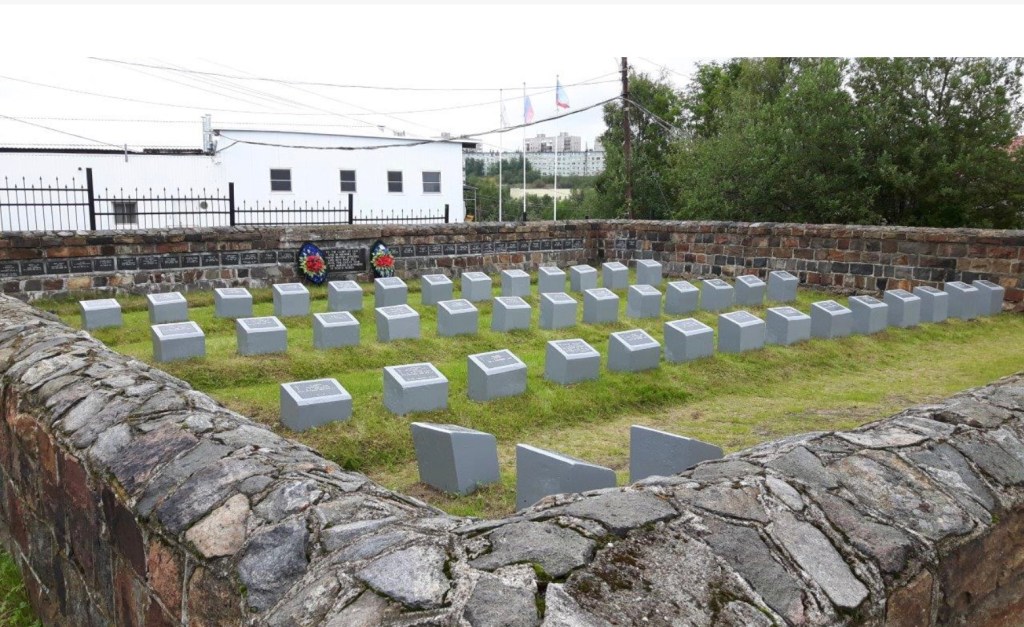
2nd Lieutenant Plumpton was buried in a small military cemetery in nearby woodland ‘amidst the eternal snow’.
A few weeks later, Robert Plumpton’s watch was found and a group of Russians were tried by a Russian court martial. Private Harrison, who was on guard duty at the court alongside Russian guards, reported that three prisoners were sentenced to death and others to penal servitude.
In 1930, 40 burials, including the remains of 2nd Lieutenant Plumpton, were moved to a new cemetery outside Murmansk. In 1991, the cemetery was renovated, with headstones and tablets financed by UK veterans.
Robert Plumpton is also commemorated at the grave of his parents, Robert and Ann, in the All Saints Cemetery, Newcastle.
Contrary to Private Stanley’s understanding, Robert Plumpton did not have any children at the time of his death but his widow, Jeannie, gave birth to their son on 14 February 1919, Valentine’s Day. Tragically, the child, Robert Taylor Plumpton, died on 26 February 1920 and is buried in All Saints Cemetery with his grandparents. Jeannie continued to live at 49 Coquet Terrace until at least the late 1930s.
Conclusion
This article has attempted to tell a little of the history of the early years of the odd numbered side of Coquet Terrace by focussing on the lives of just a few of the people who built it or lived there. It is only the tip of the iceberg so please get in touch, if you’d like to add to the story.
Acknowledgements
Researched and written by Chris Jackson, Heaton History Group. Thank you to Jonathan Craven for allowing Chris access to his house deeds and title, to Paul Elliott, who researched Robert Plumpton’s story for the Green Howards Museum website and to Colin Jackson, who carried out research on behalf of HHG at RIBA’s library.
Can You Help? If you know more about the early history of Coquet Terrace or have photographs to share, we’d love to hear from you. You can contact us either through this website by clicking on small speech bubble immediately below the article title or by emailing chris.jackson@heatonhistorygroup.org
Sources
Ancestry
British Newspaper Archive
‘From Galaxies to Turbines: science, technology and the Parsons family’ , W Garrett Scaife; Institute of Physics Publishing, 2000
Graces Guide to British Industrial History
‘Modern Housing in Town and Country’ / James Cornes; Batsford, 1905
‘Murder in Murmansk’ / The Green Howards Museum
Wikipedia
Other online sources, where possible referred to / linked to from the text.

