

Susan Denham Christie was born into a shipbuilding dynasty and her achievements would have made her distinguished family members proud. Fittingly, it was the sight of a support vessel on the Tyne bearing Susan’s (married) name that alerted Heaton History Group member Arthur Andrews to her importance.

He was delighted to discover that she was a long-time High Heaton resident.
Background
Susan Mary Denham Christie was born on 10 January 1915, the daughter of John Denham Christie and his wife, Mary. Her father, John, was described in the 1911 census as a ‘shipbuilder’ and ‘employer’ and, in 1921, as ‘managing director of Swan Hunter Wigham Richardson’ based at the firm’s Neptune Works in Walker. He went on to become chairman of the company.
At the time of Susan’s birth and during her childhood, the family lived in Tynemouth. There were four live-in servants: a waiting maid, a house maid, a cook and a children’s maid.
John’s own father, a Scotsman, had worked with Brunel on the ‘SS Great Eastern’, the largest ship in the world at the time. He came to the north-east to work as a manager for Wigham Richardson and rose to the position of company director.
Susan had an older brother, Paulin, who also went on to be a director of Swan Hunter, as well as holding directorships of the Hopemount Shipping Company, Wallsend Slipway Engineers and Tyne Shipbuilders.
In 1957, Susan and Paulin presented a lectern to Holy Saviour’s Church in Tynemouth in memory of their parents. It can still be seen in the church.


Susan’s engineering heritage and specifically her connections to maritime industries on Tyneside ran deep. It is perhaps not surprising then that she launched her first ship, the ‘SS Cuba’, in 1923 aged just eight.
Susan’s maternal grandfather, Paulin Martin, was a surgeon and in 1871 her grandmother, by now a widow, was the ‘proprietress of a private asylum’. Her own mother, Mary, who was born and brought up in Gloucestershire, had attended Cheltenham Ladies College as did Susan herself later.
She had undoubtedly been born into a prosperous family but also one in which female members, as well as the males, were well-educated, economically active and successful.

Pioneer
In 1932, the Christies relocated from Tynemouth to ‘Glendyn’ on Jesmond Park West in High Heaton. Whether this was partly because it was a more convenient base for Susan, who had been offered a place at Durham University’s Armstrong College in Newcastle to study naval architecture, because it was better placed for John’s job or simply because it was an upgrade on their previous house, we don’t know. ‘Glendyn’ has since been demolished and replaced by a number of smaller properties but the name of the house lives on.

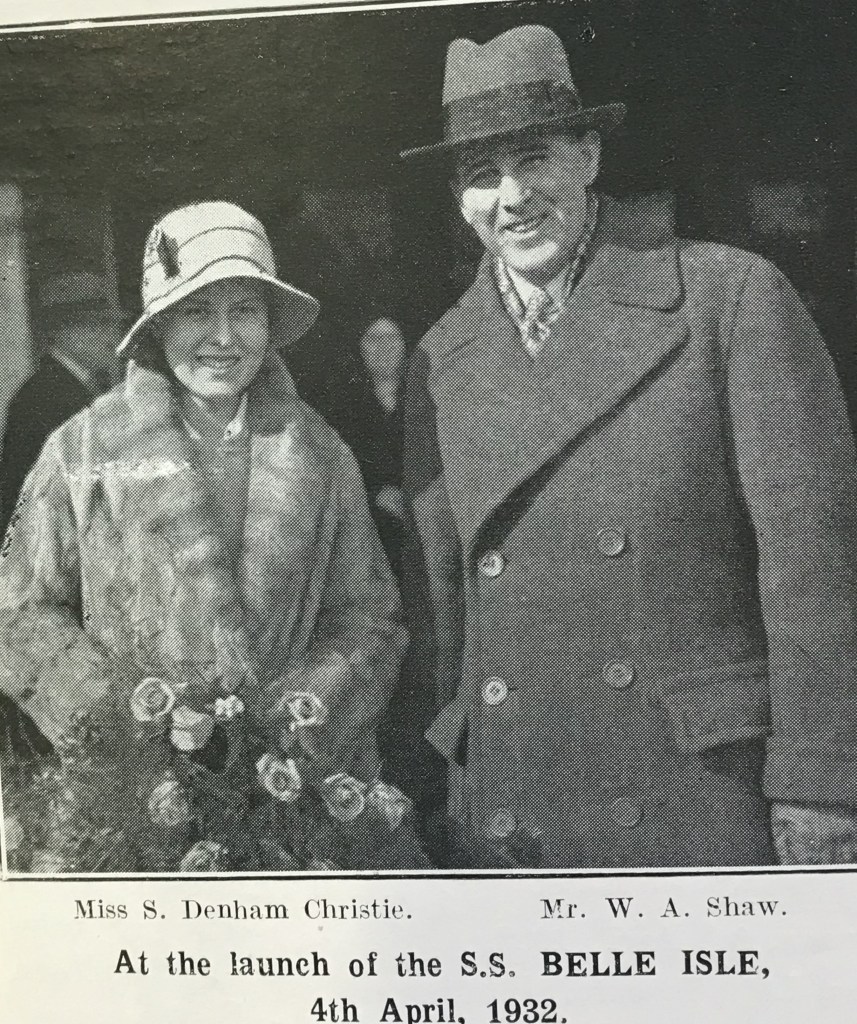
But we do know that in April 1932, aged 17 Susan launched the ‘SS Belle Isle’, for the Newfoundland Canada Steamships Ltd.
Susan wasn’t quite the first British woman to study the discipline: ten years earlier, Dorothy Rowntree had gone to Glasgow University to obtain a degree in engineering, specialising in naval architecture but, in 1936, she certainly became the first woman to graduate specifically in naval architecture.
This achievement didn’t go unnoticed at the time. It was reported in a number of newspapers and the ‘Daily Mirror’, lauding the progress towards equality of the sexes, listed what it considered to be the outstanding achievements of the year by women. Susan was on the list. Alongside her were: Jean Batten, Beryl Markham and Amy Mollison, all aviators and Dorothy Spicer an aeronautical engineer; Florence Horsbrugh, MP for Dundee (previously represented by Heaton’s Alexander Wilkie), who had become the first woman to move the address in reply to the King’s speech and as a consequence, the first MP to appear on television; artist Dame Laura Knight, only the third woman to be elected to full membership of the Royal Academy (founded in 1769); Philippa Parry Martin, appointed Huntarian Professor of Surgery, one of the highest honours in the profession; Elizabeth Frisby, the first woman to be elected High Bailiff of Leicester in the 650 years the position had existed; Jean Stephenson, appointed the first female inspector of drugs and poisons. Finally the paper recorded that Brooklands Automobile Racing Club had lifted its ban on women drivers.
Because of this national recognition, Susan was interviewed a number of times by the national media. Modestly, she said that there was nothing very remarkable about her success but she told the BBC’s Home Service that she thought the shipbuilding industry would benefit from the presence of women. She said that when she started work, the male workforce did not readily accept her. Many subscribed to the superstition that it was bad luck to allow women on ships at all during construction. To overcome this, she inspected her ships on Saturday afternoons, after the workforce had gone home for the weekend.
Susan was also reported as saying that she had gained experience in Swan Hunter’s design office, working on passenger and merchant ships but that she knew nothing yet about admiralty designs. However, war was looming.
War Service
The 1939 Register, compiled at the start of the conflict, shows the family still at ‘Glendyn’. The occupants were Susan and her mother and father, along with five domestic servants and, at the lodge, their chauffeur and his wife.
Soon Susan was part of the Swan Hunter Wigham Richardson design team for ‘HMS Anson’, which was launched in 1940 and sent in 1942 to the Arctic as an escort ship for Russian convoys. Later it was famous as the ship on which the surrender of Japanese forces occupying Hong Kong was accepted and was in Tokyo Bay during the final surrender of Japan.

She also helped design and construct ‘caissons’, the floating docks used by the allied troops to land in France on D-Day. These were referred to in 1938 newspaper headlines as being part of ‘Important Contracts for Tyneside’ as part of ‘Big Admiralty Orders’ for use at the Admiralty Dockyard in Devonport. The construction involved welding rather than riveting for the first time and when completed the caissons weighed around 2500 tons.
Susan also worked on the design of the aircraft carrier ‘HMS Albion’, launched in 1947 by Violet Attlee, wife of Prime Minister Clement. The vessel later did service at Suez.
As if this wasn’t a big enough contribution to the war effort, in her ‘spare’ time, Susan was very involved in the Civil Defence Committee. Alongside Mrs Wynn Reed, who worked full-time, she ran a section of ambulances in Newcastle.

In 1942, ‘Lloyds List’ reported that the only woman ship designer in the country was working at Swan, Hunter and Wigham Richardson and had been admitted as an Associated Member of the North East Coast Institution of Engineers and Shipbuilders. ‘Women’s Engineering Magazine’ also carried the news.
Peacetime
Susan said that attitudes changed during the war but she remained the only woman on the Swan Hunter ship design team.
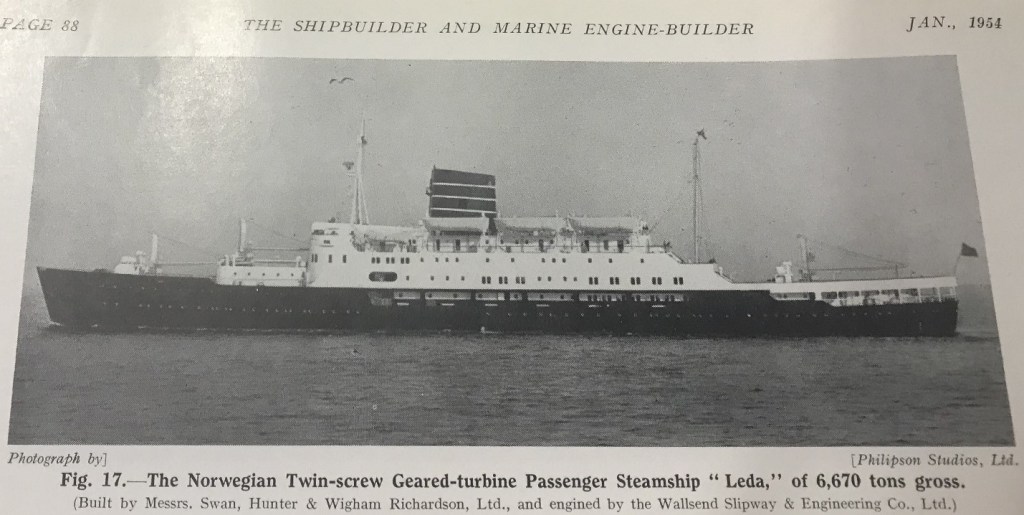
After the war ended Susan, went back to designing passenger and cargo ships. One passenger ship,’Leda’, launched in 1953 and described as the fastest ship in the Norwegian merchant navy, became a familiar sight locally. For many years it plied the route between Tyneside and Norway.
Although like most women of the time, Susan officially left work upon her marriage, she continued to write for Swan Hunter’s in-house magazine,‘The Shipyard’, under a pseudonym and to launch ships from time to time as she had done for most of her life. At shipyard apprentice dinners, she often presented prizes.

Family
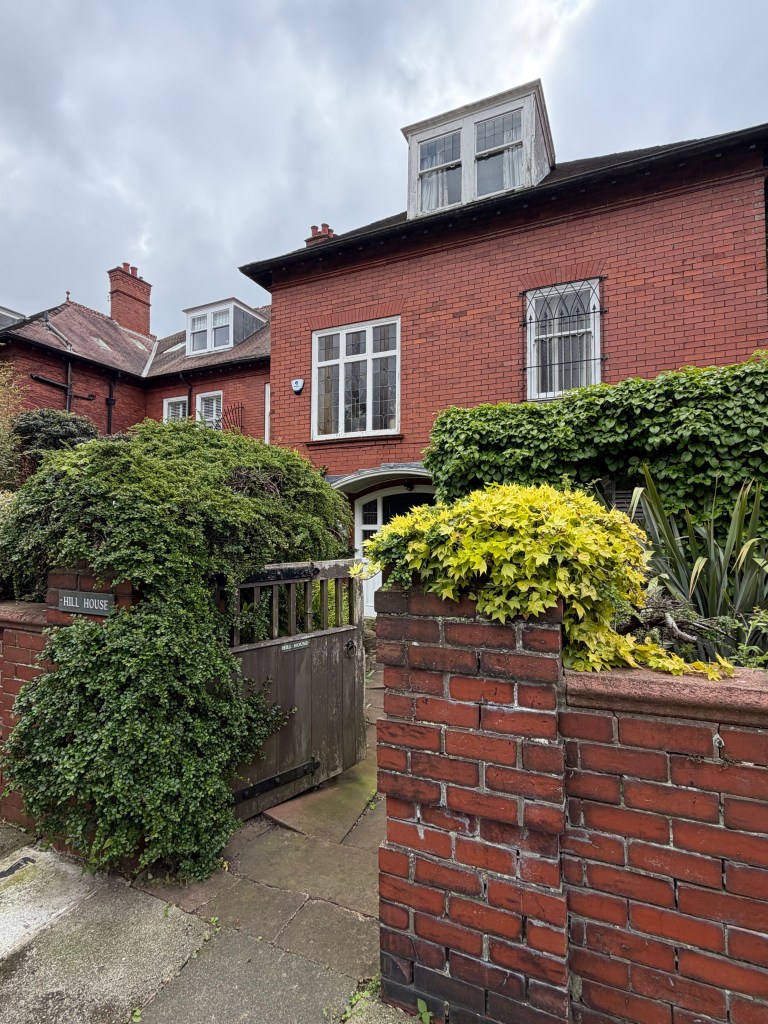
In July 1952, Susan married electrical engineer, John G Auld. The couple continued to live in High Heaton, later with their two sons, Martin and Charles, first of all at ‘Hill House’ on Melbury Road and later at the much more substantial ‘Nook House’ on a large plot of land in Jesmond Park East.



One of her sons said ‘She was a wonderful woman. She had a great sense of humour and a strong character. She was very good at her job but gave up work to look after us as she thought bringing up her children was more important.’
Susan was also a keen Northumbrian piper and won awards for her musical talent.
Susan Auld died at the Freeman Hospital on 9 March 2002 aged 87.
Remembered
In the permanent shipping exhibition, ‘The Tyne’, at the Discovery Museum there is a brief mention of Susan’s contribution, as a pioneering naval architect.

In December 2025 and January 2026, four Dogger Bank windfarm support vessels entered the River Tyne and moored on the river adjacent to The Royal Quays Marina. They were named ‘Grampian Tyne’, ‘Grampian Tees’, ‘Grampian Tweed’ and ‘Grampian Derwent’. As we have heard, on the deck of each of these imposing ships was a substantial tender. Each of these was named after a remarkable north-east woman, two of them – Rachel Parsons and Susan Auld – with strong Heaton connections. The others were Grace Darling and Alison Kay, who founded the Peoples Kitchen.
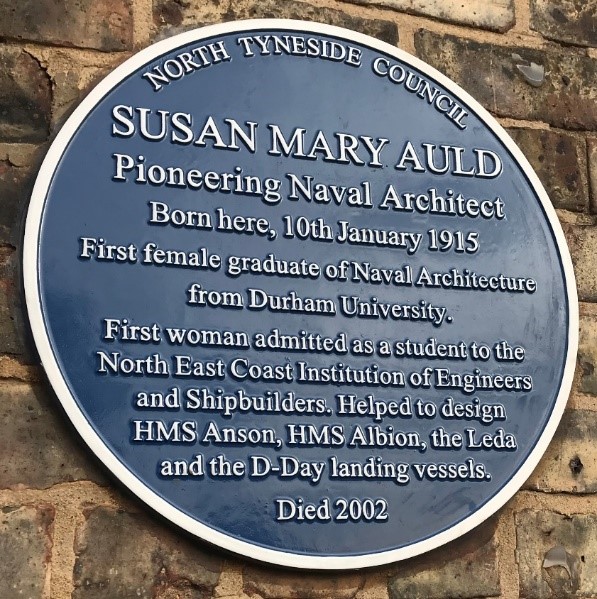
In 2022, a commemorative plaque was unveiled at Susan Auld née Christie’s childhood home in Tynemouth.
It is surely time that we celebrated Susan’s achievements here in Heaton, her home for 70 years, and especially since it is the 90th anniversary of her graduation with a B Sc in Naval Architecture.

Can You Help?
If you know more about Susan Auld née Christie or have memories or photos to share, we’d love to hear from you. You can contact us either through this website by clicking on small speech bubble immediately below the article title or by emailing chris.jackson@heatonhistorygroup.org
Acknowledgements
Researched and written by Arthur Andrews of Heaton History Group. Many thanks to Charles Auld, Susan’s son, who contacted us following publication of this article and has supplied further photographs and information. An anecdote from Charles has been added to the Comments section.
Sources
Ancestry
‘Angels of the North Volume Two: more notable women of the north-east’ / Joyce Quin and Moira Kilkenny; Tyne Bridge Publishing, 2024
British Newspaper Archive
Discovery Museum
Findmypast
Grace’s Guide
North Shields Library
Tyne and Wear Archives
First published in May 2026.


We are delighted to have been contacted by Charles Auld, Susan’s son. Photographs and further information supplied by him have been added to the article. He also wrote the following:
‘I was very interested to read the comprehensive article about my mother, Susan Auld, on your website. Nook House in Jesmond Park East was, of course, where we lived throughout my childhood. Furthermore, until I read the article, I hadn’t realised that a boat had recently been named after my mother. Actually, she would have been highly embarrassed by this – she was quite a modest person and considered that being a naval architect was really just working in the family business!
My mother also had a great sense of humour. In the mid-1960s a young woman came up to Newcastle University (which, of course, had only recently been separated from Durham University) to read naval architecture. She was interviewed by local television and asked what it was like to be the first woman to read naval architecture. She knew about my mother and, rather flustered, said: “Well, I’m not actually the first: there was one in the 1930s, but she’s past it now.” Thereafter, my mother used to say, with a twinkle in her eye: “I used to work as a naval architect – but I’m past it now”!’