

Benton Park House was an impressive 18th century mansion house set in parkland which occupied the area now largely taken up by the Cochrane Park Estate to the west of Red Hall Drive. Though the early years of the house are not well documented it appears that the house was built by the Bigge Family, a prominent dynasty of attorneys, merchants and landowners. The Bigges increased their wealth by leasing out the coal loyalties which they owned here (in what was formerly the Township of Little Benton), and elsewhere in Northumberland. Another house built by this family, Benton Hall was located on the other side of Red Hall Drive, roughly where the Lochside Pub now stands.
Whilst the name ‘Benton Park House’ will be used in this article, the house was known by the name ‘Benton House’ during the eighteenth 18th and early 19th centuries and this appears to have led to confusion with another house in Longbenton village which later adopted that name. The name ‘Benton Park’ does not seem to have been used for Benton Park House and estate until the late 1830s. The house also later went under the name ‘The Red Hall’.
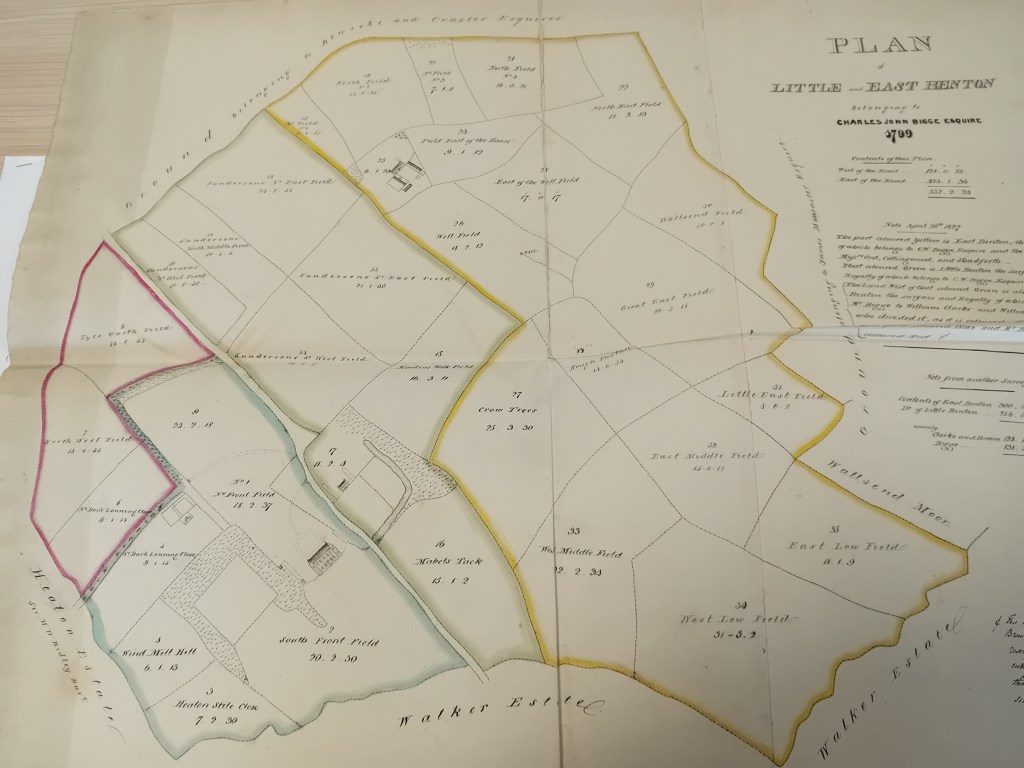
In its early days the house was the primary residence of the Bigges whose Little Benton Estate once covered some 550 acres (223 hectares) as shown on the 1799 plan below. Benton Park House is the large house shown in the bottom left hand corner of the map. The road which is shown, then called Benton Lane, and sometimes Little Benton Lane, is now Red Hall Drive, Coach Lane and Benfield Road.
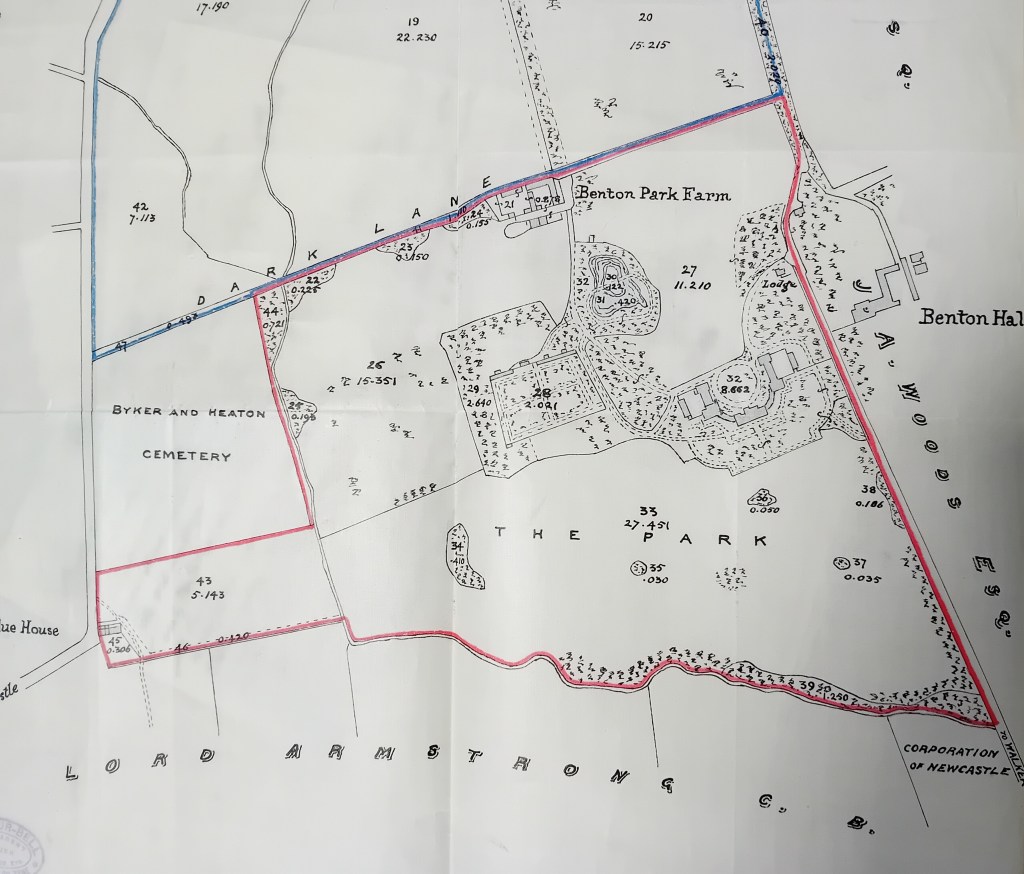
In the early 19th century the Bigge family sold off the land to the west of Benton Lane, an area of approximately 52 hectares, and approximately 36 hectares of this formed what would become known as the Benton Park Estate. The map below, an extract of an 1842 tithe map of the Little Benton township, shows Benton Park House and the boundaries of the estate at that time, outlined in red. The road shown to the north of the house (running east-west) was known as Dark Lane but is now Etherstone Avenue. Historically this formed part of the main route between the lost mediaeval village of Little Benton (the exact site of which is unknown), and Newcastle. Further north of this, forming part of the northern boundary of the estate, is the Coxlodge Wagonway which was built in the early 19th century. The Wallsend Burn forms the southern boundary and part of the western boundary of the estate. The burn, now only visible further to the east, was also part of the boundary between the historic townships of Little Benton and Heaton.

The House and Estate
The below extract from a map prepared by the architect John Dobson in 1813 for the then owner of the estate, William Clark , shows the main house (notably it is labelled ‘Benton House’) joined by curving corridors or arcades to east and west wings. The west wing is labelled ‘kitchens etc’, and the east wing ‘stables, etc’ (with stable-yard attached). There is also a brew house to the rear of the kitchens. The only detailed description of the accommodation that has been found is in a letter from an agent dated 1899: ‘The Mansion is of about 36 rooms, with a quadrangle at the back (North) one side of which contains servants office rooms on the first floor, with kitchen, still rooms and laundries on the Ground Floor; on the East side Housekeepers and Servants (Men) on the second; and stable adjoining, Billiard, Smoking Rooms on the Ground’. Unfortunately no details are given of the rooms in the main house. The house, which faced south, would have had extensive views of the area running down towards the River Tyne and of Gateshead Fell in the distance.
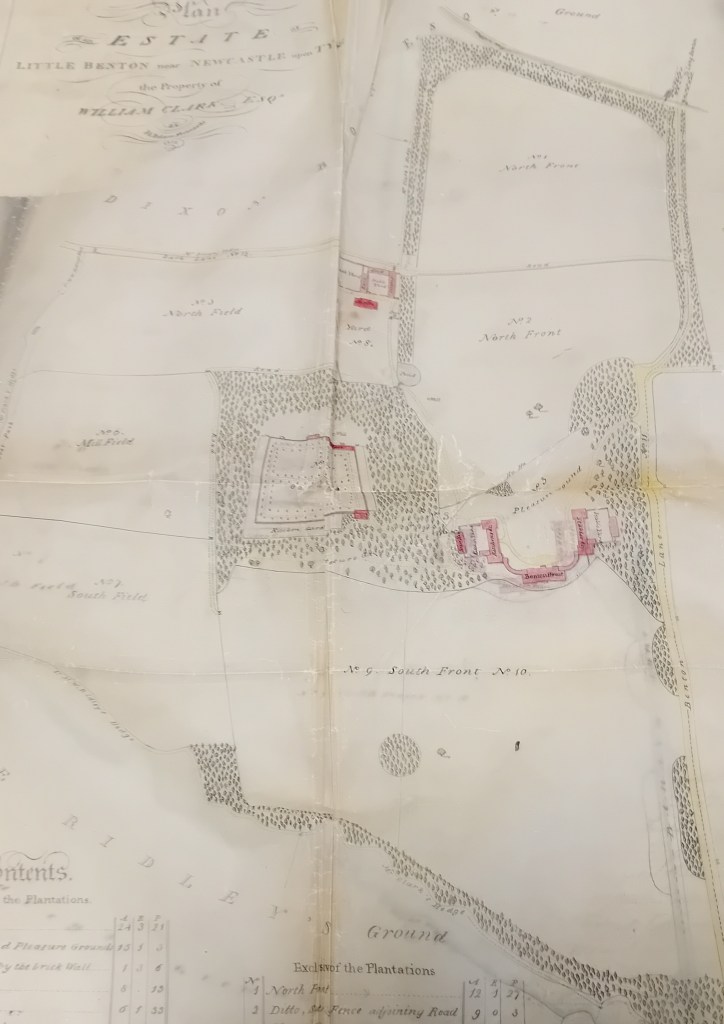
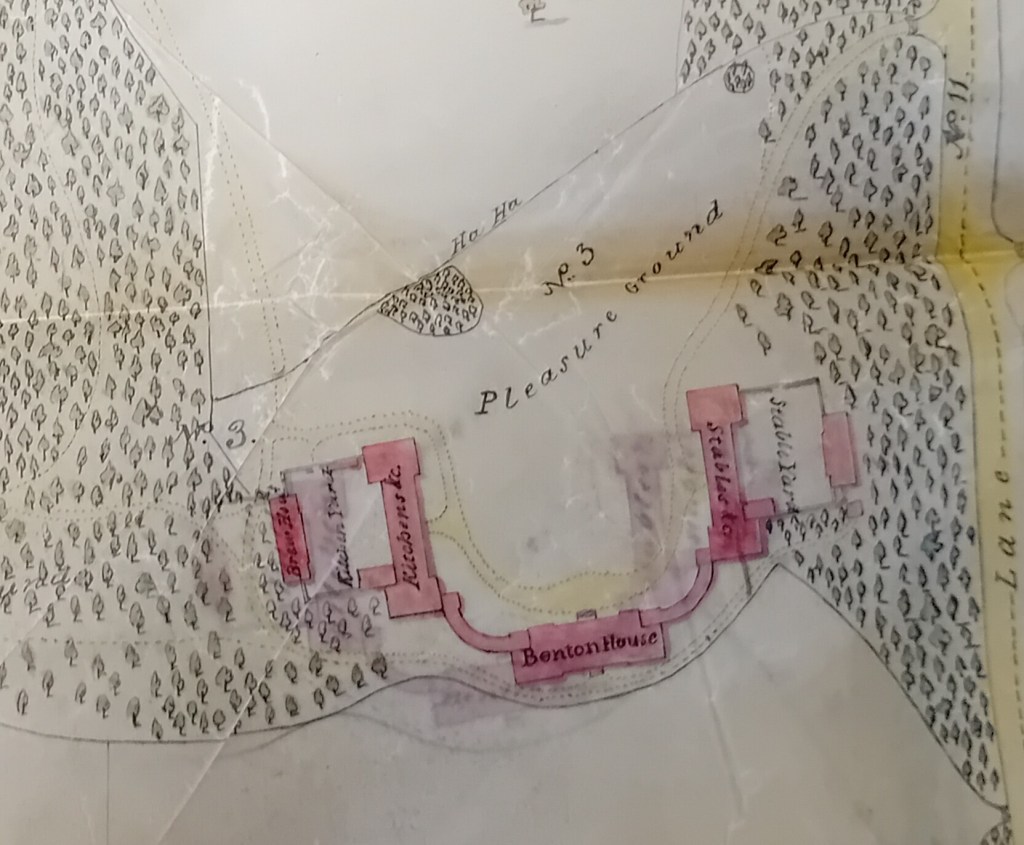
Pleasure gardens are shown immediately to the north of the house and a haha (a sunken wall constructed to be invisible from the house) is shown which would have prevented livestock from accessing this area. Access to the house is shown as coming from Benton Lane (today’s Red Hall Drive). There are extensive areas of woodland to the east and west of the house and around much of the perimeter of the estate and there is an enormous walled garden to the west of the house of approximately 0.79 hectares (for comparison Newcastle United’s pitch at St James’ Park is about 0.71 hectares). A Kitchen Garden is also shown, to the south of the walled garden, suggesting that the latter was probably used as an extension of the pleasure grounds. By the end of the 19th century some significant changes had been made to the grounds. For example, the small pond shown on the 1813 map between the house and the farm had been substantially enlarged and gardens on the south front had been extended into the park and a terrace and steps down to the lawns added (as shown on the map of 1899 which appears later in this article).
Origins
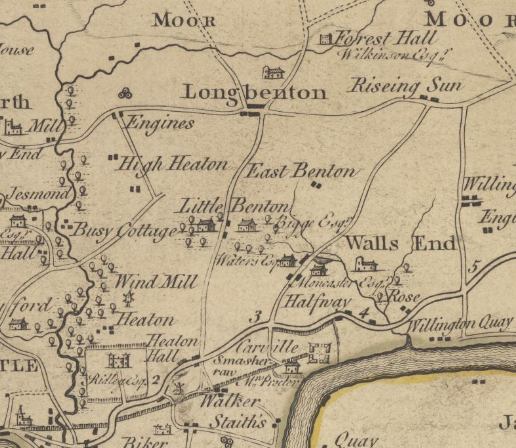
There is some confusion about when Benton Park House was built. Faulkner and Lowery (1996) say that the house was built in the late 18th century and both Davidson (2008) and Morgan (2023) give a suggested date of 1780. However, a much earlier source than these, Samuel Lewis’ ‘A Topographical Directory of England’ (1848) refers to “Benton Park Mansion, originally built a century ago, and enlarged in 1769…”. This, if correct, places the building of the house in the mid-18th century, several decades earlier than more recent sources have assumed. A similar confusion exists in relation to another house in Longbenton Village, now called Benton House, and it is hard to avoid the conclusion that the histories of the two houses may have been conflated at some point. Whilst it isn’t possible to say definitively what the actual sequence of building was, it is seems quite likely from the limited evidence we have that Benton Park was built before 1750. Newspaper reports certainly place the family in Little Benton at this time and Andrew Armstrong’s Map of Northumberland of 1769 (see extract below) shows two substantial houses in parkland at Little Benton. If this was the case, Benton Park was probably built by either Thomas Bigge (c 1675-1758) or his son William (1707-1758).
The Bigge family’s association with Little Benton area goes back to 1707 when Thomas, a wealthy lawyer and landowner, married Elizabeth Hindmarsh, the daughter of Edward Hindmarsh who settled the land which he owned in the west of the Little Benton Township on her. William, like his father, was a lawyer and at one point one of Six Clerks in Chancery, a high level legal position. In 1736 he married Mary Clarke, the sole heiress of Charles Clarke of Ovingham, gaining a fortune of £25,000 in the process. The family’s wealth grew further during the century as a result of the leasing of the coal royalties relating to their various estates, including Little Benton. Benton Park and its grounds stayed in the family’s ownership until 1808 when William’s grandson Charles William Bigge sold it, probably as a means of raising funds to develop yet another country house and estate, Linden House, in the Longhorsley Parish of Northumberland.
The Browns and Clarks
In 1808, the land surveyor Thomas Bell surveyed the estate and a handwritten note at the bottom of his map (now in the Seymour Collection in the Newcastle City Library) tells us that the estate was ‘bought of Charles William Bigge on 12 May 1808 by William Brown’. William Brown, a colliery owner, was very closely associated with the Bigge family being part of the partnership which leased the coal royalties of Little Benton from Thomas Charles Bigge and developed Bigges Main Colliery. Following the purchase it seems that Brown immediately transferred most of the estate, including the house, to his son in law Charles Clark (1766-1837) who had married his daughter Mary Brown.

Prior to moving to Benton Park the Clarks lived at Wallsend Hall, then the most important residence in Wallsend Village. Charles had been the first recorded Mayor of Wallsend and was a magistrate for the counties of Northumberland and Durham, Lieutenant Colonel commanding the Northumberland North local militia, and High Sherriff of Northumberland in 1820. Clark also purchased an estate at Belford in 1811 (becoming Lord of the Manor of Belford) which would become the main family residence of the next generation. He also seems to have owned land in Cullercoats, Monkseaton and Whitley Bay. He died at Benton Park House in June 1837.
The Potts Family
When the house and estate were offered for sale in October 1837 they were bought by Captain John Potts for £9,100. Potts was a colliery owner who had an interest in several collieries including Walker Colliery, which was one of the most important in the area, and Felling Colliery. Like Charles Clark, he was an officer in the Northumberland Militia (a report in the‘Newcastle Journal’ in June 1865 noted that the by then Major Potts was one of the three oldest surviving officers of the Northumberland Militia, having joined the regiment in 1814). Before moving to Benton Park House he occupied a large house in Wallsend Village (‘The White House’). The 1841 Census shows Potts and his wife Sarah living in the house with their 8 children and ten servants. Samuel Lewis ‘Topographical Directory of England‘ (1848) reported that Potts had ‘entirely beautified the interior’ of the mansion. Benton Park Farm, which comprised 66 acres of the estate, was leased out by the family.
In 1846 Captain Potts was the witness to a murder which took place on his estate. A man called Daniel Hives, employed on the construction of the Newcastle and Berwick Railway, was murdered on the estate by an Irish labourer called George Mathews. A description of the event and its aftermath appears in Fordyce’s Local Records.

It appears from the contemporary press reports of the case that the incident which led to the murder partly arose out of the ‘many contentions that had transpired between the English and Irish labourers on the railway’ being constructed at the time. When Mathews was hanged at the County Gaol in Morpeth on 17 March 1847 (which happened to be St Patricks’s Day), the authorities were so concerned that a large number of his countrymen working on the railway would attend and cause a disturbance, that a substantial contingent of police (reports mention 60 or 70 officers) was brought in as a precaution. While reports said ‘immense crowds flocked in from all parts‘, a special train bringing in some of these, there was no trouble on the day.
We know that during Captain Potts’ time the estate had a herd of deer. On 3 June 1854 it was reported in the Newcastle Journal that ‘The herd of deer in Benton Park, the seat of Captain Potts, having been often disturbed, and some of them missing, two police officers were directed to keep watch in the park during Saturday night. Three men were pursued and captured poaching’.
Notices advertising the estate of Benton Park for sale appeared in the local press in late 1864, the estate described as an important freehold estate ‘comprising a fine mansion and gardens, vineries, pleasant gardens and plantations, distant only a few minutes walk from Walker Station and the Tynemouth Railway, and a farm and grassland, the whole containing 88A, 2R, 4P’. An auction was arranged but was cancelled after Edward Liddell, a Newcastle corn merchant, purchased the property by private contract in January 1865. In the following month the contents of the house were auctioned off, the advert for the auction stating that the auction was ‘in consequence of a Change of Dynasty’. Some of the more unusual items advertised for sale at auction included ‘Silken Cord with Globular Handles, from Napoleon’s Couch at St Helena’ ‘Tons of the Choicest Specimens of Chrystalised Spar from the Geological Formation of Alston and Elsewhere’, and ‘An Alderney Cow, in milk’.
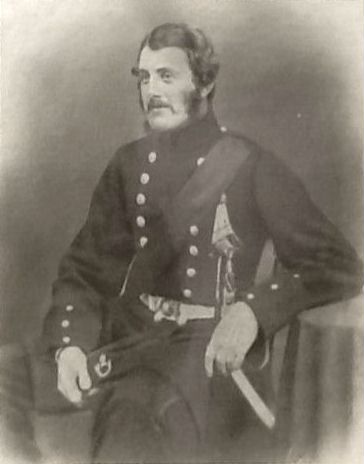
A report which appeared in the Newcastle Daily Chronicle in 1891 noted that a businessman called James Colpitts had at the time of the 1865 auction floated the idea to potential partners of making the estate into ‘an enclosed racecourse, pedestrian ground and zoological gardens, after the model of Manchester Belle Vue undertaking’. Although Colpitts ultimately failed to raise backing for the project he claimed that he had ‘put Mr. Liddell in the way of buying it and he got a splendid investment‘.
Major Potts died in London in 1870, a few years after his wife. Both are buried in St Peters Churchyard, Wallsend.
The Liddell Family
Edward Liddell (1815-1879) moved to Benton Park from Jesmond where he had leased the Mansion and Estate of Jesmond Park. The 1871 Census shows Edward living at Benton Park House with his family and 10 servants. Born in Newcastle, the son of Cuthbert and Abigail Liddell, Edward is described in documents as a corn merchant or corn factor. An elder brother of his, Matthew Liddell, was a prominent colliery manager/viewer who lived at another local mansion, Benton Grange (located near to what in now the Haddricks Mill Roundabout). Edward’s wife, Anne Amelia, was one of the daughters of Richard Grainger of ‘Grainger Town’ fame. Apparently her name, and those of her siblings, were used in the naming of some of her father’s new streets in Elswick. It seems Edward also later acquired a large estate at Newton-by-the sea which had until 1860 been owned by Major Potts, the previous owner of Benton Park.
Edward died at Tynemouth in December 1879 and his widow, Anne Amelia, died in March 1886 at Benton Park. It seems that at that point the property passed to their three children, although they either did not live in it or did so only for only a brief period. In May 1887 the contents of the house were auctioned off and the house and estate were put up for auction in 1891, the auction advert showing that even at this time the potential of the property for development was recognised: ‘Situated as it is in immediate proximity to the City… and bordered and intersected by good roads, the property possesses unusual importance and whether with a view to present occupation or for development as a building estate, for which it is now ripe, offers a most desirable investment’.
For some reason the estate did not sell at that time and it appears that from 1891 the farm and stables were leased out and a steward was appointed to look after the remainder of the property. In July 1891 a horse dealer, Frank Doyle, advertised in the ‘Newcastle Daily Chronicle‘ that ‘ as a consequence of the increasing demand for High Horses, he has taken the stables at Benton Park’. As late as 1906 there is mention in the press of a ‘Benton Park Stud’ and there is also reference to a horticultural nursery.
A letter in the Seymour Bell Collection dated February 1899 confirms that the house by then had been empty for 11 years, although ‘fires have of course been kept on in the past winters’. Seymour Bell (a local land agent) made enquires about the property in 1899 and was told initially that any offers would be immediately put forward to the owners. However, shortly afterwards he was informed that the owners of the estate, ‘two brothers and sister, difficult to communicate with as the former are generally travelling’, had now determined not to sell.
Later Years
It appears that a portion of the estate was sold in 1913 for an extension to Byker and Heaton Cemetery, which had opened to the west in 1890. In the late 1920s or early 1930s the Edward Liddell Trustees then sold the remainder of the estate to the North Heaton Development Company Ltd, a property development company established in 1928 which was responsible for much of the suburban housing developed in the northern part of Heaton in the 1930s and 1940s (prompted in part, no doubt, by the completion of the new Coast Road in 1927). The development of the Cochrane Park Estate, which would take up most of Benton Park, commenced in the mid-1930s following the demolition of Benton Park House.
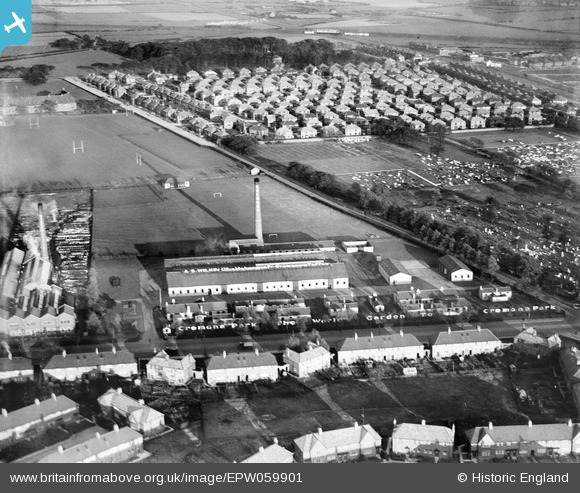
As the aerial photograph above (taken from the west in 1938) shows, the development of that part of the Cochrane Park Estate to the west of Red Hall Drive was completed before the Second World War commenced. The estate is named after the adjacent sports ground which was donated to Armstrong College by Sir Cecil Algernon Cochrane. Early adverts for housing in the area specify that houses were available from £450. Local historian Alan Morgan notes that some of the estates street names (including Sherfield Drive, and Longridge Avenue) seem to relate to locations associated with the Liddell family, the house’s last occupants.
The southern part of the Benton Park Estate ( ie the portion of it which lay between the Coast Road and the Wallsend Burn) was developed, along with land purchased from the 1st Baron Armstrong, for what was called by the developers ‘The North Heaton Bungalow Garden City’ (now more prosaically referred to as North Heaton bungalows).
Acknowledgements
Researched and written by Alan Richardson of Heaton History Group, 2026.
Can You Help?
Unfortunately it has not proved possible to locate any photograph of Benton Park House. The photograph which appears in Faulkner and Lowery’s ‘Lost Houses of Newcastle and Northumberland’, supposedly of the house, is actually of Benton House in Longbenton. If you have, or are aware of, any surviving photographs of the house or any of its owners or occupiers, Heaton History Group would be pleased to hear from you.
References
‘Bygone Days of Longbenton, Benton, Forest Hall, Westmoor and Killingworth’ / W G Elliot and Edwin Smith (undated)
‘A Guide to the Historic Parks and Gardens of Tyne and Wear’, Fiona Green, Tyne and Wear Specialist Conservation Team (1995)
Heaton, Cochrane Park, Benton: How we used to live’ / Alan Morgan (2023)
‘A History of Wallsend’ / William Richardson (1923)
‘Lost Houses of Newcastle and Northumberland’ / T Faulkner and P Lowry (1996)
‘Northumberland’s Lost Houses’, Jim Davidson (2008)
‘A Topographical Directory of England‘; 7th Edition, Samuel Lewis, London (1848)
Various papers from the Seymour Bell Collection (Longbenton Portfolio), Newcastle City Library
First published in March 2026.


Thank-you for this much needed history of the area and its occupants.
A superb job… well done.