

There are, at the time of writing, only four correct answers to the question ‘Which football managers have won the English top flight league title with more than one club?’ The most recent was Sir Kenny Dalglish with Liverpool (1885-6, 1887-8) and Blackburn Rovers (1994-5); perhaps the most famous, Brian Clough with Derby County (1971-2) and Nottingham Forest (1977-8): even further back was Herbert Chapman with Huddersfield Town (1923-4, 1924-5) and Arsenal (1930-31). But the first, as well as the most successful, indeed the only one to win the top division more than once with both of his title-winning clubs, was a Geordie and an important footballing figure in the east end of Newcastle before he led other teams to glory.
Early Life
Thomas Watson was born on 8 April 1859 to Walker-born Mary Ann Watson and her husband, Ralph, an iron moulder, while they were living on Heaton Street in Newcastle. While Heaton Street was officially in the township of Byker (and the municipal ward of Jesmond), it was, as the name suggests, about as close to the then sparsely populated Heaton as you could get. It was just south of the railway line close to the spot where the theatre which, when it was first built, was known as ‘Heaton’s Grand Theatre,’ later stood and next to Heaton Terrace, part of which still stands in an area dominated by car repair businesses and the like in the shadow of Morrisons.
The 1861 census shows Thomas as the older of two boys, his younger brother, John, being just seven weeks old. The 1871 census shows the Watsons still living on Heaton Street , with another three children having joined the family: Elizabeth Priscilla, now eight; Robert William, three and Margaret, one. Father, Ralph, was still employed as an iron moulder; the older children were all at school. The Watsons’ neighbours included a shipwright, a bookkeeper, a potter, a stationer’s assistant and two police constables.
In 1878, Tom, as he was by now usually known, married a Gateshead girl, Catherine (Kate) Lucas and the couple set up home together on Rosehill Terrace in Wallsend, where their first child Ralph Lucas was born soon afterwards.
Football
The address is significant because it was while living there that Tom founded a football club which he named Rosehill Football Club. Accounts vary as to where Tom was first exposed to ‘Association Football’. Newspaper reports written towards the end of Tom’s life say it was while at school in York but under what circumstances would a working class boy from Byker go to school in York when his parents appear not to have moved from the east end of Newcastle? After being in Heaton Street at the time of the 1861 and 1871 censuses, Mary and Ralph were at the same address in Grafton Street, still in Byker, in both 1881 and 1891, before eventually relocating to 38 Whitefield Terrace in Heaton by which time Tom had long moved out of the area.
Another connection with Heaton was that in 1887 Tom’s younger sister Elizabeth Priscilla married John Peel Oliver who, in 1902, became a director of Newcastle United. He went on to become chairman of the club between 1919 and 1928. The 1911 census gives their address as Bellegrove, 38 Lesbury Road, Heaton where they were still living ten years later. Elizabeth died in 1938 at her home, now Oakdene, Jesmond Park West, High Heaton.
Newcastle United’s official historian, Paul Joannou, cites a different influence. He reports that Tom was inspired by a match between St Bernard’s and Rangers that young Watson watched while on a visit to Scotland. Either way, Tom loved and was proficient in a number of sports. As well as being the founder and secretary of Rosehill FC while in his mid twenties, he also played for the team as well and turned out for Rosehill Star Cricket Club.
West End
It wasn’t long before, even more than his ability on the field, Tom’s leadership and organisational skills were noticed by an ambitious club on the other side of Newcastle. In summer 1886, the now twenty seven year old Tom joined West End as club secretary. The club had been founded four years before and, at first, played on the Leazes, where the Royal Victoria Infirmary stands now but they were about to move to a sloping sheep field not too far away, a ground which could be enclosed and so to which an entry charge could be made. Tom is said to have been instrumental in getting permission for West End to play on the field. The takings at the first match at what would later be named St James’ Park, were reported to be seven shillings and eleven pence. Tom’s wife, Kate, was said to have been the only woman present on this historic occasion.
It is often reported that Tom’s stay at St James’ Park was curtailed following an incidence of overcrowding at a cup-tie held at the ground between the Cramlington team, Shankhouse, which had been given permission to use the ground, and Aston Villa. It is said that spectators spilled onto the field of play, delaying the kick-off and that, as secretary, Tom was held responsible and was forced to leave the club. There was certainly a record crowd at the game but neither we not Newcastle United historian Paul Joannou have found any contemporary evidence that this happened. Indeed, a lengthy report of the match in the Birmingham press specifically mentions that the game kicked off exactly on time. That certainly wasn’t always the case in those days so was worthy of note. But whatever led to Tom’s departure, West End’s loss was East End’s gain.
East End
When Tom Watson joined East End, the team appeared to be on a downward trajectory. The Eastenders had won the Northumberland Challenge Cup and the Northumberland Charity Shield in 1885, while still playing in Byker. Indeed they had retained the latter trophy the following year. At that time, before the foundation of the national Football League and the chance for teams to regularly see how they matched up against opposition from across the country, which came three years later, East End were demonstrably the best side in Northumberland.
Their ground in Byker had become inadequate for the size of the crowds the team could now attract so, for the beginning of the 1886-7 season, the club had relocated to a ground half a mile north at Heaton Junction on Chillingham Road, land which nestled close to the busy railway line (and on which a housing estate has recently been built). Here they installed a pavilion, fencing, even a press box. The facilities compared very favourably with the muddy, sloping sheep field on which their cross-city rivals played! And in their first match at the new ground, they won a derby v West End 3-2 in front of a crowd of about 2,000. The ‘Heatonians’ had arrived.
East End’s record victory by a score not surpassed even in the 130 years or so since the club was renamed Newcastle United, came in January 1888 against Point Pleasant. The score was 19-0 and star player, Heaton boy Alec White, scored around nine of them, depending on who was counting.
However, results overall that season, were disappointing and East End mustn’t have been able to believe their luck when the highly regarded West End secretary, Tom Watson, a local man to boot, became available.
At this time, a secretary would usually be a club’s named contact, ensure compliance with football and local authority rules, arrange fixtures, keep records and communicate with the local papers. But it was widely known that Tom Watson did much more. He took a lead in player recruitment, team selection and tactics. In short, he could claim to be the first modern football club manager. His recruitment of players was key to his teams’ success. From the start of his managerial career, he would personally visit targets in Scotland and entice them to Newcastle with the promise of work and a signing on fee.
The effects were instantaneous. Bolstered by signings from north of the border, in 1888/89, under Tom Watson’s guidance, East End won a remarkable treble: the Northumberland Challenge Cup, Northumberland Charity Shield and the Northumberland and Durham Inter County Cup.
And Watson didn’t limit himself to managing his club, in March 1889 it was reported in ‘Athletic News’ that ‘ A gentleman who has had much to do with the advances of the sport in Newcastle, Mr Tom Watson, the East End honorary secretary, has called a meeting [to which] about 20 clubs haling from the ground extending from Middlesbrough to Morpeth will be invited to send representatives regarding the establishing of a league for the far north’ (18 March 1889). However after first being influential in the setting up of the Northern League, by the time Tom was installed in the summer of 1890 as the first secretary of the new Northern Alliance, formed ‘after several leading clubs in the north had set up a league of their own’, he was at the helm of a new team, having received another offer he couldn’t refuse.
At first it was reported that the Heaton club were allowing Watson to depart ‘with good grace’. A testimonial game in his honour was played at Heaton Junction in summer 1889 and a farewell dinner was planned.
However, even before the 1889/90 season had begun, the mood had changed. When they heard that Watson had been sent on a recruiting mission to Scotland by his new employers, the East End board asked him to do them a favour and secure a couple of named amateur players for them. This might sound naive now, but when the players concerned, Tom Porteous, and J Stevenson, signed for Watson’s new club instead, the Heatonians were aggrieved. Its signing, in addition, of the Heaton club’s popular captain, Jock Smith, another Scotsman, can’t have helped.
Sunderland
The team for which Tom Watson left East end was Sunderland AFC. Not only was he offered a considerable pay rise but crucially the Wearside club, which had been formed ten years earlier as Sunderland and District Teachers AFC, was further ahead in its development than East End and was bank-rolled by wealthy shipyard owners whose ambitions matched those of its new manager.
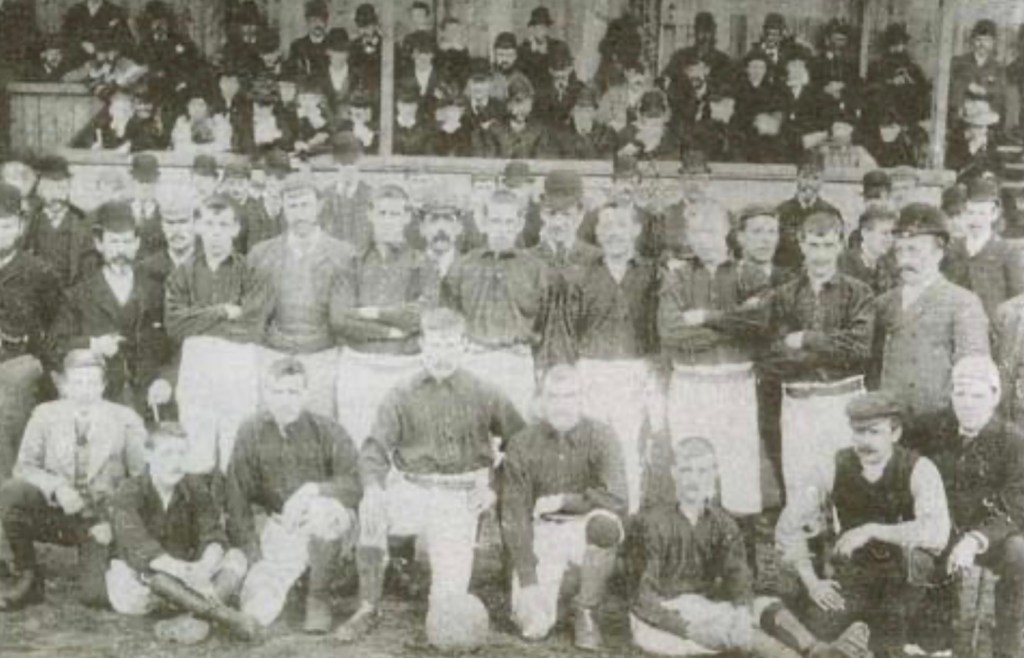
With a team largely made up of Scots recruited by Watson and including the pair ‘stolen’ from under the nose of East End, Tom Porteous, who had in fact been born in Newcastle, and J Stevenson, as well as Jock Smith, their former captain, Watson’s Sunderland enjoyed a superb first season, beating a number of teams who had been elected to the Football League for its inaugural season. Notably, the victories included a 7-2 humiliation of the mighty Aston Villa. During Watson’s first year in charge, Sunderland played 55 matches; won 40, drew 5 and lost 10, scoring an amazing 182 goals in the process.
The Football League’s founder and Villa board member, William McGregor, said Sunderland had a ‘talented man in every position’, a phrase that soon morphed into ‘The Team of All the Talents’.
It was no surprise then that the Wearsiders were elected to the Football League for its second season. The club’s ambitious Geordie manager now had a national profile. The first season was one of consolidation with the team finishing mid table. The first team squad of 16 comprised 12 Scots and just four Englishmen, Porteous among them.
The following year, 1891/2, Sunderland were champions, a feat repeated in 1892/3. This time the team completed the full season unbeaten at home, scoring 100 goals. Tom Porteous featured in every game. Jock Smith played 14 times. What might have been for East End?
Although Sunderland narrowly lost out to Aston Villa in 1893/4, they were champions again the following year. Indeed they went on to win the club ‘World Cup’ against Scottish champions, Heart of Midlothian, with a team made up entirely of Scottish players. In fact, everyone on the pitch that day was Scottish: the players of both teams, the referee and both linesmen,
An epic four-all draw with the reigning champions Villa, in January of that season, was immortalised by local artist Thomas Hemy. This historic painting is on display at the Stadium of Light with a copy in the National Football Museum. Running the line in the background, holding a flag, is said to be Tom Watson. Neutral officials were, in the main, for the future! You can read more about Hemy and the painting here.

The ‘Team of All the Talents’ had peaked but age was catching up with many of them. They finished the 1895/6 season in 5th place with Aston Villa champions again. Gates were down too and the board was unwilling or unable to finance the signings needed to compete with the best.
Tom Watson’s star, however, was still in the ascendancy. He had already, at the age of 36, won three league titles, which puts him, at this point, on a par with Stan Cullis (Wolves), Jose Mourinho (Chelsea), Bill Shankly (Liverpool) and Arsene Wenger (Arsenal) across their whole careers. But another change of club beckoned.
Merseyside
Liverpool FC had only been founded in 1892, a breakaway from the much more established, wealthier, more successful and better-supported Everton. Jock Smith, former East End captain and one-time Sunderland player, had scored their first ever goal in the Lancashire League v Higher Walton but the owners were ambitious. The club had yo-yoed between the first and second divisions of the football league a couple of times but when they were promoted again in April 1896, the board of directors had no hesitation in offering to double Tom Watson’s Sunderland wages to a huge, at that time, £300 a year. According to a report in ‘Sporting Life’, Newcastle United (as East End were now called) also tried to persuade Tom to return but the board wouldn’t match the salary on offer on Merseyside. Watson’s departure seems to have been amicable, with gifts showered upon him by both players and local reporters. A large crowd, including Sunderland players, saw him off at the railway station. Home from now on for Tom, Kate and their children Ralph, Ethel, Tom junior and Winifred would be Liverpool.
Watson made sweeping changes to the playing squad during his first season and the team finished a creditable 5th in the First Division in addition to reaching the semi finals of the FA Cup, losing to the eventual winners of both competitions, Tom’s old rivals Aston Villa. The following season, however, Liverpool seemed to regress. They finished ninth, having struggled to score goals. Nevertheless, Tom Watson was a very popular figure on Merseyside. His efforts to grow junior football in the area in order to reduce the club’s dependence on Scottish talent and create a route into the sport for local boys were particularly appreciated.
The following season, 1898/9, was more successful. Tom Watson continued to improve the squad and he reduced the average age of the team to 24 years and they went into the final game of the season with a chance of winning the League. Unfortunately for them, that final fixture was away at Villa Park, new home of the serial winners from Birmingham. They lost 5-0. And the next season, they slumped to tenth place. Would Tom Watson ever be able replicate the success he’d enjoyed in the north-east? Perhaps a new century would lead to a change of fortune.
Liverpool enjoyed a strong start to the 1900/01 season and in November they beat Aston Villa 5-1. Ups and downs followed but when, in February, after losing three of their previous four games, Tom Watson’s Liverpool won 1-0 at his former club Sunderland, they knew the title could be theirs. They didn’t lose another match, a run which included another win against Aston Villa and a 3-0 victory over Newcastle United.

Liverpool were champions for the first time in their history and Tom Watson had become the first manager to win the title with two different clubs. And, in leading a team to the championship for the fourth time, he was the equal of both Chapman and Dalglish who, like him, were to win it with two clubs and Frank Watt, who had been Secretary of Newcastle United since 1895 but who was soon to lead the Magpies to three titles in close succession (1904/5, 1906/7, 1908/9) during their Edwardian heyday before remarkably adding a fourth, almost 20 years later, in 1926/7. Incidentally, Watt also won the FA Cup twice with Newcastle and was at the helm for a remarkable 37 years – before being succeeded by his son, who served for another 21!
In 1901/2, however, Liverpool were to finish a disappointing 11th and in 1903/4 were relegated, the first real setback of Watson’s career. Nevertheless the club stood by their secretary (These were different times) and he led them back up as champions in 1905. And the following year they were First Division champions once more.
They actually lost their opening three games and the season was marred by a crush at the sell-out Merseyside derby, with supporters spilling onto the Anfield pitch. (Perhaps this incident caused confusion for later historians some of whom transposed it to St James’ Park some twenty years earlier.) But luckily nobody was seriously hurt and the season ended happily for Tom, the players and fans.
A hard-fought win at Tom’s former club, Sunderland, kick-started their season. They also beat champions Newcastle United 3-2 at St James’ Park and 3-0 at Anfield. Liverpool had become champions again in 1906 and their points total of 51 (with two points awarded for a win) had never been bettered.
This was Tom Watson’s fifth league title, a feat which Sir Matt Busby (with Manchester United) and Pep Guardiola (Manchester City) were later to match. Only Bob Paisley OBE (six titles, also with Liverpool) and Sir Alex Ferguson (with an unsurpassed 13 for Manchester United) won more. And Tom had won five titles by the age of 47, by far the youngest manager to have done so.
Liverpool didn’t come close to winning the league title again over the next few seasons, during which time Watson was constantly rebuilding his team while it finished 15th (1907- New castle United were champions ), 8th (1908 – Manchester United champions), 17th (1909 – Newcastle United again). A highlight of the 1909/10 season at the end of which an improved Liverpool finished runners up to Aston Villa was a 6-5 victory over Newcastle United at Anfield, a game which they were losing 5-2 at half time. Forward Ronald Orr, signed by Watson the previous year after seven successful seasons with Newcastle United, scored two of the comeback goals and assisted another.
They also won 4-3 in the first ever game at Old Trafford. But the Merseysiders record generally continued to be unremarkable: 13th in 1911 (Manchester United champions), 17th in 1912 (Blackburn Rovers), 12th in 1913 (Sunderland), 16th in 1914 (Blackburn Rovers again). But Watson did lead Liverpool to their first FA Cup Final at Crystal Palace that season where they were beaten 1-0 by Burnley. He never managed to win the cup and it was to elude Liverpool until as late as 1965.
Untimely Death
The 1914/15 season was a particularly difficult one. It was played, of course, against the backdrop of the early days of the First World War. Casualties were mounting as the season progressed and many players and supporters had already left to serve in the armed forces. It was a time of worry and uncertainty. In a letter to the ‘Times’ in November 1914, Tom Watson listed the measures the club was taking to help the war effort. They included players being drilled by a retired army officer two days a week; collections at the ground; players donating 12.5% of their wages to the local war fund; the club providing soldiers, sailors and Belgian refugees with free entry to matches and sending 18 footballs to troops. Clearly Tom Watson had much more on his mind than trying to win football matches.
His mood won’t have been helped by a match-fixing scandal that occurred as the season drew to a close. 0n 2 April 1915 Liverpool lost 2-0 to Manchester United but it emerged that players of both sides had placed large bets on that outcome. The result ensured that United would avoid relegation. Watson was not implicated in any way and by no means all the players were involved. But four Liverpool players and three from United were found guilty and received lifetime bans, although all but one had them lifted in 1919 in recognition of their wartime service.
The final action of the season took place over the weekend of 24 April. By beating title contenders Oldham Athletic at Boundary Park, Liverpool effectively handed the championship to their greatest rivals. Everton, whose final game wasn’t until the following Monday, could celebrate in advance.
It had been a hard few weeks for Tom Watson.
Two days later on 28 April, the Football League was suspended for the duration of the war. Plans were being drawn up for regional tournaments and it would have fallen to Tom to begin to recruit players who were not away with the forces to play for Liverpool in the Lancashire Section Principal Tournament. He was also planning a trip to the United States on football business.
But a week later, the ‘Liverpool Echo’ reported that ‘Owd Tom’ had been taken ill after apparently catching a chill at a match the previous week. The following day, 6 May 1915, at his home in Anfield, Tom Watson died of pneumonia, a disease for which there was no effective treatment until Alexander Fleming discovered penicillin in 1928. Tom was 56 years old.
He was buried in Anfield Cemetery just across Stanley Park from the ground where he was so loved. The headstone was added to his grave in 2015, courtesy of Liverpool Football Club and Sunderland AFC. It is great to see his association with East End acknowledged.

Legacy
At Liverpool, Watson is credited not only with masterminding the club’s first two league titles but also with implementing innovative training methods and driving stadium improvements including the building of the famous Anfield Kop. He had also already signed six players who were integral to the next title winning Liverpool team, the back to back title winning sides of 1921/2 and 1922/3. He is still the club’s longest serving manager, for that is what he was in all but name.
In Newcastle at the very beginning of his career, Tom Watson had redefined the role of club secretary first of all with West End and then East End, paving the way for the modern football manager who (until recently at least) ran things both on and off the field.
An article in the ‘Liverpool Echo’ just after his death also credited Watson with having a ‘distinct influence on popularising the game on the Continent’. And it seems that his untimely death may have been a factor in the sport being slow to take hold in the USA. ‘Mr Watson had recently arranged to visit America this summer, where no doubt he would have further spread the popularity of the game.’
All through his career he was reported to have been ‘popular with everyone’, ‘bluff, hearty, fond of a joke’. His book of contacts throughout the country (and beyond) was said to have been second to none. ‘Only last March….he kept us intent for an hour or more with tales of Russia and with his meetings with Royalty there’.
One of his former Liverpool players, Alex Raisbeck wrote ‘people could not help liking Tom Watson, for he had a way with him of making good and lasting friends. He magnetised by his charming personality’.
The ‘Newcastle Journal’ called him ‘one of the leading pioneers of professional Association football’ and said ‘Whilst associated with [West End] he headed a deputation which resulted in the Newcastle Freeman and the Newcastle Corporation granting permission for football to be played on the site now known at St James’ Park in the occupation of the Newcastle United Football Club.’
The boy from Heaton Street in Byker who led Heaton’s East End FC to glory is now commemorated, thanks to the efforts of Heaton History Group and the cooperation of Keepmoat Homes, by a street named after him on the housing estate which now stands on the old Chillingham Road ground at Heaton Junction. It’s the least this pioneering figure, the first manager to lead two clubs to the English title and the only one of the elite to win it more than once with both clubs and arguably the one to have the most transformative impact on the sport, deserves.

The road is appropriately called ‘Watson Drive‘ for it was Tom Watson’s energy and ambition alongside his understanding of the game and of people, his creativity and business acumen that separated him from not only his peers but from most of the football managers who have followed in his footsteps over the last century and more.
Can You Help?
If you know more about Tom Watson or have photos or memories to share, we’d love to hear from you. You can contact us either through this website by clicking on the link immediately below the article title or by emailing chris.jackson@heatonhistorygroup.org
Acknowledgements
Researched and written by Chris Jackson of Heaton History Group. Thank you to Paul Joannou and Kieran Smith for their help.
Sources
‘All with Smiling Faces: how Newcastle became United 1881-1910’ / by Paul Brown; Goal Post, 2014
‘Newcastle United: the ultimate who’s who 1881-2014’ / by Paul Joannou; N Publishing, 2014
‘Red Dawn: the ballad of Tom Watson and Liverpool FC’s first champions’ / by Jeff Goulding and Kieran Smith; Pitch Publishing, 2025
plus Ancestry, British Newspaper Archive and other online sources.

