

John Robinson Glendenning, a 42 year old cigar merchant and tobacconist, settled into Stannington Avenue, Heaton, in 1897. Yet he was born on 18 February 1856 in Adelaide, the capital of the British colony of South Australia. Even more remarkably, he was probably conceived in Sunderland shortly after his parents’ marriage on 1 March 1855! How to explain such an incredible journey?
For the answers, we have to turn to his parents. His father, William Glendenning, born in Bishopwearmouth, Sunderland in 1829, was the eldest son of a Scotsman from Parton, Kirkcudbrightshire (Glendenning was a famous name among the Border Reiver clans in the Scottish West Marches). His mother was Ann Matilda Robinson, the 21 year old daughter of John Robinson of Hunstanworth, Durham.
Life in Sunderland in the 1850s cannot have been easy. There was no doubt employment in the traditional industries of coal mining, steel and shipping, but what if you were an adventurous young man looking for something more? We can only guess at the reasons, but something prompted the young William and his wife Ann to undertake the arduous months-long voyage to Australia.
What we know is that the British government was encouraging young couples to go out and settle the new free settlement of South Australia, different from the existing penal settlements of New South Wales and Victoria, with the promise of assisted passage and favourable land grants on arrival.
Voyage
Even so. why should a newly married young couple subject themselves to such a long journey? The likely answer was two-fold. One was the land being offered either free or at very low rates by the new colony in an attempt to attract settlers. Another reason may have been family knowledge – other Glendennings had already migrated to South Australia in the 1840s and 50s in search of their fortune.
In the 1850s and 1860s, Adelaide and the South Australia region were expanding rapidly. Yet the region was still small, without a metropolis to compare with Sydney or Melbourne. Ships were departing from England at regular intervals carrying migrants for the growing colony. Although the passengers were free men and women, the ships carrying them had been transporting convicts to the penal settlements only a few years earlier. Ships like the Sunderland-built sailing barque ‘Castle Eden‘, which departed Southampton on 11 September 1862 and arrived at Port Adelaide, South Australia on the 26 December carrying some 200 migrants for the colony.
For the Glendennings, one attraction may have been gold, the possibility of striking it rich in newly opening up and gold-rich territory. Rumours of finding gold were beginning to spread in southern Australia, and such stories were already attracting fortune hunters and entrepreneurs from around the world. What a chance, to strike it lucky and change your family’s fortune at a stroke!


Whatever their motivation, William and Ann embarked on the ship ‘Theodore’ at Liverpool on 2 July 1855, bound for Port Adelaide. The trip would have been no picnic. Sailing to Australia meant a long, hard and perilous journey across the southern Atlantic and round Cape Horn, a graveyard for sailing ships that had been notorious for centuries.
Hopefully their voyage was smoother than on the ‘Castle Eden’. On a voyage in 1850 carrying settlers to New Zealand, that ship’s passengers reported that, ‘Illness became prevalent on board with diarrhoea, typhus fever and whooping cough among the ailments. With dwindling medical supplies, perished food stores, steerage passengers experiencing great discomfort in cramped and wet conditions, and members of the crew disobeying orders, the Surgeon Superintendent Thomas Haylock and Captain Thornhill saw fit to touch at Cape Town on 12 December.’
At Cape Town, ‘the entire crew were arrested for mutinous behaviour. Once the crew were replaced, they were off at sea again with stores replenished and a number of new hands on deck. The ‘Castle Eden’ was back on course. According to passenger reports, the second crew weren’t much better than the first, indulging heavily in the onboard rum.’
However, it seems according to the ‘Adelaide Times’ that young William and Ann Glendenning arrived safely at Port Adelaide on 3 Nov 1855, after a four month voyage. And the colony’s public records showed that Ann gave birth to their first son, John Robinson Glendenning, on 18 February 1856 in Norwood, Adelaide. This is the John Robinson Glendenning who would one day live in our house on Stannington Avenue, Heaton.
Goldrush
If the couple were hoping to strike it lucky, information would have been scarce. Early reports of finding gold on the outskirts of Adelaide were quashed by the authorities – they feared their plans for steady and orderly development in tune with the landscape could be overturned by a California-style gold rush. They were right to fear so – as more and more news spread about finding small deposits of gold, the number of settlers built rapidly.
An early gold find in January 1846 by Captain Thomas Terrell at Castambul in the Adelaide Hills ended up being made into a brooch sent to Queen Victoria. Samples were displayed at the ‘Great Exhibition’ at the Crystal Palace in 1851. That same year of 1851, significant new finds were made at Castlemaine and Bendigo in the neighbouring state of Victoria, then a separate colony.
News of such finds spread throughout Australia and overseas, eventually bringing about goldrush fever in the southern states. Triggered in 1851, the Victorian gold rush was the only major gold rush that predominantly comprised immigrants from overseas. Over 350,000 prospectors arrived from the UK, Ireland, China, continental Europe and the United States. Within a decade, gold production from Victoria comprised some forty per cent of total world production.
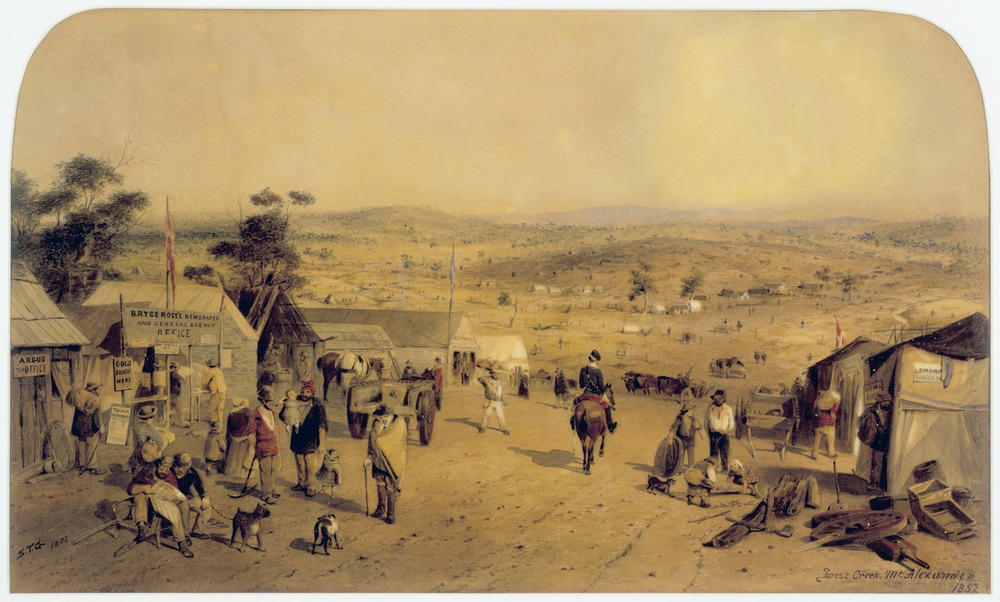
Castlemaine Diggings, scene of the 1852-54 Mount Alexander gold rush, was the first major goldfield in Australia to attract a huge influx of voluntary immigrants. With gold sitting just under the surface, the shallowness allowed diggers to easily unearth gold nuggets. In seven months, over two million pounds weight of gold was unearthed from Mount Alexander and transported to nearby cities.
In the decade between 1850 and 1860, gold fever brought a significant increase in immigration to the colony of Victoria, with 290,000 people migrating from the British Isles alone. Australia’s total population increased nearly fourfold from 430,000 in 1851 to 1.7 million in 1871, and the country developed its first multicultural society during the period (source: Wikipedia).
Perhaps the news of these strikes influenced William and Ann. Because within two years they and their young son John Robinson had moved from South Australia to Victoria. On the 23 September 1858 the Melbourne Public Lands Office records that the Receipt & Pay Office in Castlemaine granted deeds of title to 10a and 8a of land at Muckleford to William and John Glendenning. The boy was only two years old at the time, but perhaps William was thinking ahead (that or he deliberately deceived officials as to the true age of his son).
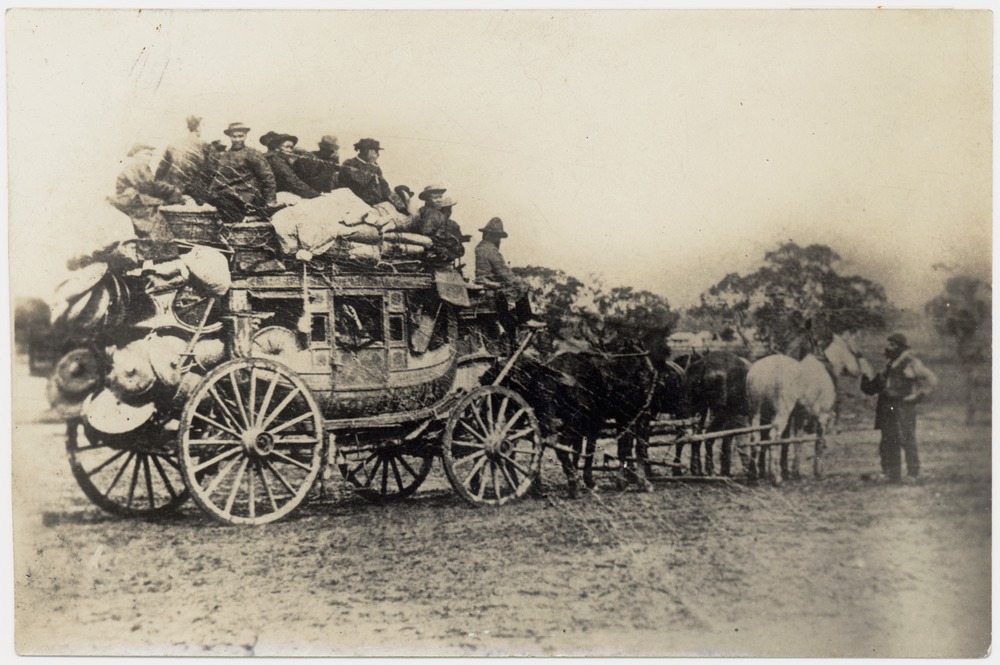
Where is Muckleford? It is right in the midst of the Mount Alexander gold fields, not far from Castlemaine, Victoria, and the centre of the goldrush fever then convulsing the country. The family stayed in the area for at least three years – for in 1861 another son was born in Castlemaine, George Hamerton Glendenning.
Conditions
What were conditions like in the gold fields of Mount Alexander? Harsh and primitive, if the few records available are any guide. The slopes and valleys of the mountain would have been strewn with tents and dilapidated wooden huts, sufficing only for somewhere to sleep, since the daylight hours would be consumed with grubbing, panning and sifting for that elusive gleam of gold.
There would have been a sense of competition certainly, especially if your plot was upstream or down from that of another prospector. And no doubt a certain element of crime, despite official attempts to award clearly delineated patches of land to specific prospectors.
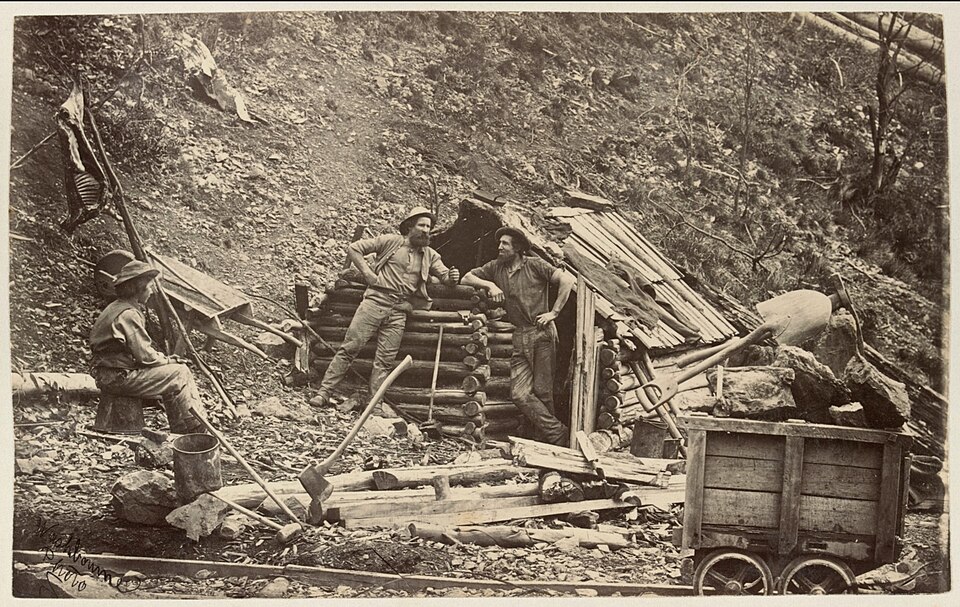
Hard manual labour and poor conditions could have brought sickness and disease – record keeping, such as it was, makes no mention of any attempt at latrines. Presumably they were constructed, if at all, on an ad hoc basis by small groups of neighbouring prospectors.
It’s likely that most prospectors’ wives and families stayed in the nearest towns and cities, such were the primitive conditions of prospecting. However it seems that some of the more hardy wives did share their husbands’ hardship on the gold fields, possibly running small local facilities, such as soup kitchens, for profit.
Did William strike gold? Unfortunately there are no records of gold finds in Victoria during the goldrush period, probably because by its very nature, coming across gold and striking it rich was a secretive business. So we don’t know if William Glendenning and his family struck it lucky or not, However it seems that for one reason or another, in 1862 the family left Australia and returned home to Sunderland.
Return
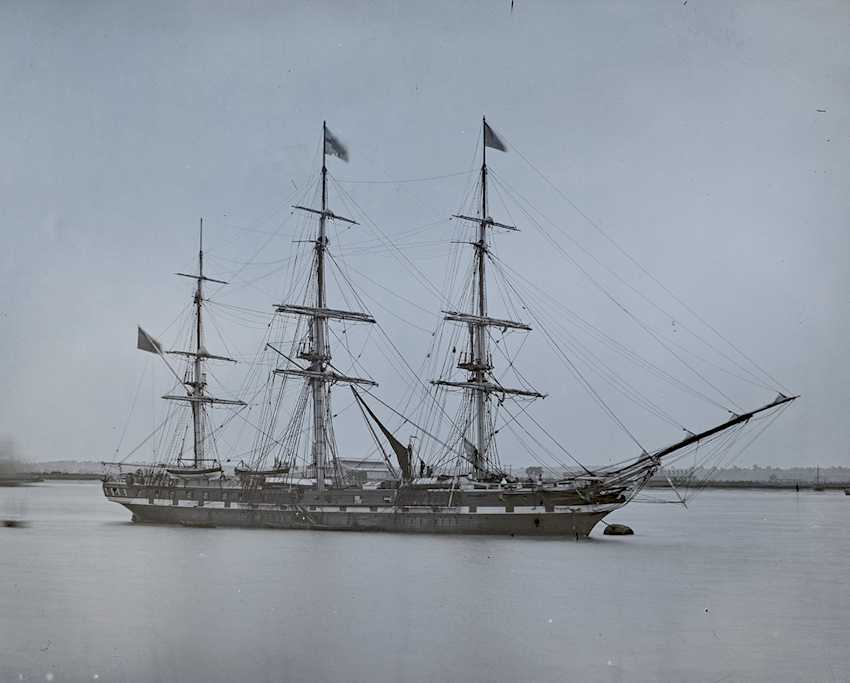
The Victorian shipping records don’t correspond exactly, but on 27 May 1862 a Mr Glendinnen aged 41, Mrs Glendinnen aged 29, a John Glendinnen aged about 5 (probably our John Robinson), William Glendinnen aged 3 and a one year old infant (could be Joseph Alfred born Castlemaine 1859) all embarked in a 2nd class cabin on the ship ‘Lincolnshire’ from Melbourne, Victoria, bound for London. It is almost certain that this is our family, and that they returned to north-east England because a daughter, Dorothy, was born in Sunderland in 1863.
By 1871 the family had moved to Newcastle. Forty-two year old William Glendenning seems by now to have become a successful wine and spirits merchant, living with the rest of his family briefly on Clayton Street in the city centre, before they moved to Jesmond. The household now comprised William and Ann, their six children including eldest son John Robinson and George Hamerton, two of Ann’s sisters, Mary Ann and Rachel Robinson, and two servants.
Unfortunately Ann Glendenning passed away on the 15 April 1875 aged just 44, possibly the combined result of a hard life and the constant risk in childbirth. Unusually, she was buried in the Robinson family burial plot at St James Churchyard, Hunstanworth, Durham rather than under the Glendenning name.
In 1881 William was still operating his established wine and spirits business on Grainger Street, Newcastle (a premises beneath the Victorian County Hotel opposite the train station), while continuing to live in Jesmond. Son, George Hamerton, worked as a solicitor’s general clerk while still living in the family home. Eldest son John Robinson had become a cigar and tobacco dealer with premises on Newgate Street, also while still living at home.
Ten years later in 1891, John Robinson had left the parental home (he was 35) – he was registered as a commercial traveller and living as a boarder in the centre of Newcastle. By 1894 he had opened new premises for his cigar and tobacco business at 3 Newgate Street (Goulbourn’s Yard). Interestingly, in 2026 the commercial premises at no 3 Newgate Street seems to have vanished off the face of the earth! No 1 is a solicitor’s office, although it does have what could be an ancient carriageway entrance. Next door at nos 5-7 is the Rose & Crown pub, popular with football supporters.
Heaton
By 1897, John Robinson Glendenning had moved into Stannington Avenue. He lived there for the next four years, while maintaining his tobacconist shop in town. At this point, he was still single. On 2 July 1892 he was recorded as campaigning for the Conservative candidate, one Charles Frederic Hansul, in Newcastle’s local elections, .

By 1901, However, John Robinson had moved back to Jesmond, where he lived with a housekeeper, Lilliane Isabelle Wood (from Bothal, Cumberland). And by 1902 he was on the move again to Arthurs Hill, before returning to Jesmond by 1904.
Life after Heaton
William Glendenning, John’s father, who had begun the whole Australian adventure, passed away aged 74 in Newcastle on 19 November 1903. He was buried at Newham, near Bamborough.
So do we know if William and his family ever struck lucky in the Australian goldrush of the 1950s-1960s? The fact remains that on his return to the north-east he started up what was by all accounts a successful wine and spirits business, and passed it on to his family when he died in 1903. In addition, in his will he left to sons William George Glendenning and George Hamerton Glendenning (but not to John Robinson or any other children) the sum of £17,509 7s 6d, equivalent to almost £2 million today. It seems likely that a certain quantity of gold or its equivalent in currency made it back to Newcastle in 1862!
The following year, the name on John Robinson Glendenning’s tobacconist business changed to ‘Finlay & Son, tobacconists’. The Finlays continued the business through 1905 and 1906. The firm had its origins on Collingwood Street in 1847 and expanded until it had branches throughout the UK for much of the 20th century. It eventually became part of Imperial Tobacco before closing for good in the late 1980s.
In 1911, John Robinson Glendenning was still listed in the census as a tobacconist, but with no premises shown. Lilliane Isabelle Glendenning, his one-time housekeeper, was now recorded as his wife and they had two children, eight year old William and six year old Dorothy.
John passed away at Newcastle in June 1915 aged 59.
Afterwards
In 1921, Lilliane was registered as a boarder living in Carlisle, together with her daughter, Dorothy, who was now aged 15.
What kind of a man was John Robinson Glendenning? He does seem to have lived a fairly rackety kind of life, one which was dominated by his father William until his death in 1903. Perhaps family history and genetics given the Glendennings were a well-known border reiver clan, had something to do with it. In any case novelty, or change, was a part. Imagine a childhood spent moving from one Australian colony to another in the search for gold, or the months spent at sea on the long voyage back to the UK. Depending on his temperament, it could have been wonderful. Less so if he was more timorous in character.
How relevant was the fact that he was not included as beneficiary in his father’s will of 1903. The tobacconist’s business appears to have folded at about the same time as his father’s death. We have also been unable to confirm his marriage to Liliane (apart from what is noted on the census form) or his place of burial. And the fact that Liliane was boarding far from Newcastle after his death suggests that his family was not so well provided for. In the end of course we will never know – the past, as L P Hartley once wrote, is a foreign country.
Postscript 1 – indigenous peoples
For migrants to Australia in the 1850s and 1860s, the goldrush represented an economic boom time and a fantastic opportunity. Certainly the period transformed the lives of many incomers, as did it the colonies themselves. Nevertheless, we now know that the story was not such a happy one for Australia’s indigenous communities.
The Australian colonies, both convict-based and free settlements, were responsible for large-scale displacement of Australia’s indigenous inhabitants, a fact that was ignored for many years for reasons of both inconvenience and embarrassment.
The colonies gradually became self-governing states and attitudes to the original inhabitants improved as governments became more established. But there can be no doubt that large-scale settlement of land would have caused conflict between settlers and the existing peoples accustomed to a hunter-gatherer lifestyle.
The boom years of the Australian goldrush would have made matters worse, there being a huge difference between pastoralist settlement (i.e. farming) and mineral exploitation, which meant surface grubbing and sifting along stream beds for gold, destroying large areas of land in the process. Unsurprisingly, the indigenous reaction to destruction of their environment became violent, which drew an equally violent response.
Britain disposed of some 160,000 criminals to Australia’s convict colonies, and a further 350,000 free settlers arrived from all over the world during the goldrush period alone. As a consequence perhaps one million indigenous people were dispossessed in a variety of violent and not-so-violent ways. A legacy that means Australia’s colonial history remains a live political topic today.
Postscript 2 – prospects of success
It seems that in all likelihood William and his family did strike it lucky in the Australian gold rush, and made enough money to be able to finance a successful wine and spirit business on their return home to the north-east of England. But there is another possibility.
Perhaps they were not successful in their attempts to find gold. Many prospectors did fail, presumably from not being lucky enough to be on a patch of land with gold deposits. In many cases prospecting efforts did not pay, or didn’t pay sufficiently well to make it worthwhile continuing. The cost of a gold prospecting licence in Victoria in 1850 was one pound per month, whether you struck lucky or not.
Yet young William and Ann first settled in Adelaide, at a time when the British colony of South Australia was expanding fast. And between the 1840s and 1860s groups of German Lutheran settlers arrived, attempting to escape from religious persecution in Prussia. They intended to try and build new wineries in the colony, and had brought grapevine cuttings from Europe with them.
Those settlers found that the climate in the Barossa valley, just 37 miles north of Adelaide, was well suited to the wine grape, in particular the Shiraz or Syrah grape variety. Barossa’s dry, hot climate helped ripen the grapes fully, producing dense and more flavourful wines.
The Barossa valley is now one of the leading suppliers of Shiraz wines in the world, with prices to match. Some of the oldest Shiraz vines in the world, planted in 1847 in Tanunda, Barossa valley, remain in commercial production today. Is it possible that William made some useful contacts among those early settlers during his time in Adelaide?
Such an outcome would help explain William setting up as a wine merchant on returning to Newcastle. As Australian wines slowly became better known on European tables during the 20th century, his contacts and experience would have made him well-placed to take advantage of any developing enthusiasm for ‘new world’ wines. Did they perhaps enable him to establish a successful Tyneside wine business and to leave a generous bequest to two of his sons, enabling them to continue the business after he passed on? We can only speculate but either way, John Robinson Glendenning’s journey to Stannington Avenue was a long one and his stay quite brief.
Can You Help?
If you know more about John Robinson Glendenning or anyone mentioned in this article or have memories or photos to share, we’d love to hear from you. You can contact us either through this website by clicking on small speech bubble immediately below the article title or by emailing chris.jackson@heatonhistorygroup.org
Acknowledgements
Researched and written by Philip Hunt of Heaton History Group.
First published on this website on 7 September 2026.

